

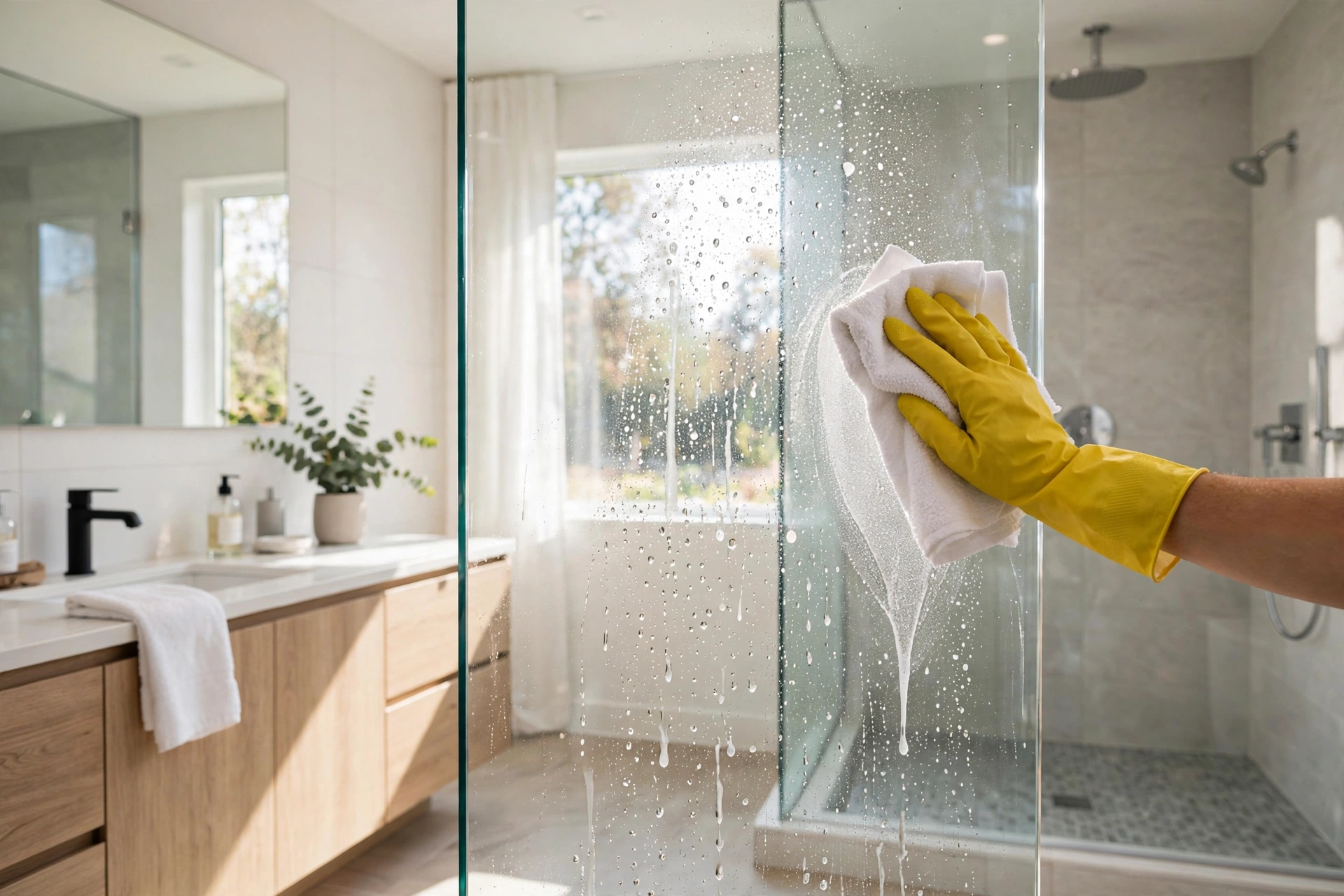
I’ll be honest with you — for about six months, I was taking showers behind glass that looked like frosted bathroom windows. Not the trendy kind. The kind where water had dried on it so many times that the whole door had this cloudy, milky film on it, dotted with white spots that wouldn’t budge […]
I’ll be honest with you — for about six months, I was taking showers behind glass that looked like frosted bathroom windows. Not the trendy kind. The kind where water had dried on it so many times that the whole door had this cloudy, milky film on it, dotted with white spots that wouldn’t budge no matter how hard I scrubbed.
I tried just wiping it down with a bathroom spray. Nothing. I tried scrubbing harder with a sponge until my arm hurt. Still nothing — just slightly cleaner-looking cloudiness, which somehow made it more depressing. For a while I just… lived with it. Every morning I’d step in and the glass looked like it had cataracts.
Then one weekend I decided enough was enough, and I went down the rabbit hole. I tested pretty much every method people swear by — the vinegar tricks, the baking soda pastes, the lemon thing, even a proper descaler for the worst corner. Some worked brilliantly. Some were a waste of a Sunday. In this guide, I’ll walk you through exactly how to remove hard water stains from shower glass, in the order I’d try them, so you can stop where it works and save your weekend.
Table of Contents
What Hard Water Stains Actually Are (and Why Your Glass Looks Like That)
Here’s the part nobody told me until I looked it up: those white spots aren’t soap scum. Well — not only soap scum. If you live anywhere with hard water, your tap water is full of dissolved minerals, mostly calcium and magnesium. Every time water runs down your shower glass and evaporates, those minerals get left behind.
One dried droplet is nothing. But hundreds of showers later, those mineral deposits build up into a layer called limescale. That’s the chalky white stuff. And the longer it sits, the more it bonds to the glass surface — especially if your shower gets hot and steamy, because heat speeds up the whole process.
Soap residue makes it worse by gluing itself to the mineral layer, which is why the glass looks cloudy rather than just spotty. My shower glass had both: a general foggy film plus stubborn round white spots, especially near the bottom where water pooled and dried slowly.
The good news: if it’s just mineral deposit sitting on the glass, it can come off. The bad news, which I’ll get to later, is that sometimes the glass is actually etched — permanently damaged — and no amount of scrubbing fixes that. So first things first, let’s start with the gentlest method and work our way up.
Once I understood what limescale actually is, learning how to remove hard water stains from shower glass stopped feeling like guesswork and started feeling like chemistry.
Before You Start: What You’ll Need and a Safety Warning
The good news about learning how to remove hard water stains from shower glass is that almost everything in this guide uses stuff you already have at home. But before you touch a bottle, please read this, because it’s important:
Never mix vinegar with bleach or harsh chemical cleaners. Vinegar is an acid, bleach is alkaline, and combining them creates chlorine gas — which is genuinely dangerous. If you’ve been using a bleach-based bathroom cleaner, rinse the glass thoroughly with plain water first and give it a few minutes before switching to any vinegar-based method. Honestly, just don’t use bleach and vinegar on the same day in the same shower. Not worth the risk.
Keep acids off natural stone. If your shower has marble, limestone, travertine, or any natural stone tile or trim, keep vinegar and lemon juice away from it. Acids etch and dull stone finishes, and that damage is permanent. If you’re not sure what your tiles are, test your cleaner on a tiny hidden spot first.
Now, the supply list. For most of these methods you’ll need: white distilled vinegar, baking soda, a couple of lemons or bottled lemon juice, dish soap, a spray bottle, a squeegee, old towels or microfiber cloths, and an old toothbrush for the edges. That’s it.
How to Remove Hard Water Stains From Shower Glass With Vinegar (Start Here)
This is the method that should be your first stop every time you need to learn how to remove hard water stains from shower glass. It’s the simplest, the cheapest, and honestly it handles about 70% of cases on its own. White distilled vinegar is a mild acid (acetic acid), and it dissolves calcium deposits through a straightforward chemical reaction — the acid breaks the mineral bonds and turns them into something that rinses away with water.
Here’s exactly what I did:
- Fill a spray bottle with undiluted white distilled vinegar. Don’t dilute it for stained glass — you want full strength. Warm it slightly if you like (I ran the bottle under hot tap water for a minute). Warm vinegar seems to work a little faster, though I can’t promise that’s science.
- Spray the glass generously. You want it visibly wet and dripping, inside and out. Open the bathroom window or turn on the fan first — the vinegar smell is strong, though it fades fast.
- Let it sit for 30 minutes. This is the part people skip, and it’s the whole secret. The acid needs dwell time to dissolve the deposits. For light spots, 15–20 minutes might be enough; for my cloudy disaster, I gave it a full half hour and re-sprayed once halfway through when it started drying.
- Scrub gently with a non-scratch sponge. Use the soft side, not the scouring side. Work in circles. You’ll feel the texture change as the mineral layer loosens — it goes from gritty to smooth.
- Rinse with hot water and squeegee dry. Don’t skip the drying. If you let it air-dry, you’re just starting the cycle over again.
When I finished this step, the difference was honestly dramatic. The general cloudiness was maybe 80% gone. But the stubborn round spots near the bottom — the ones that had been building up for months — were still there, faint but visible. That’s normal. Vinegar alone often needs a second pass, or you move to Method 2.
My tip: If your spots are light, do the vinegar spray twice before moving on. Two rounds of gentle acid beat one round of something aggressive.
Method 2: Baking Soda Paste for Stubborn Spots
When you tackle how to remove hard water stains from shower glass in stages — acid first, gentle abrasion second — the remaining spots stop being a mystery. Where vinegar is a dissolver, baking soda is a gentle polisher. After the vinegar round, my remaining spots were thinner but still clinging on — they needed a little physical help. Baking soda (sodium bicarbonate) is a very mild abrasive, far softer than glass, so it scrubs the residue off without scratching.
Here’s the method:
- Make a thick paste — about three parts baking soda to one part water. You want the consistency of toothpaste, not soup.
- Spread it over the remaining spots with your fingers or a soft cloth. Be generous on the worst areas.
- Let it sit for 15–20 minutes. For really stubborn patches, I lay a damp paper towel over the paste to keep it moist — dried paste doesn’t do much.
- Scrub in small circles with a soft cloth or sponge. Old toothbrush for the corners and the metal frame edges, where gunk loves to hide.
- Rinse thoroughly. Baking soda leaves a white film if you don’t rinse well, which is ironic given the whole point of this exercise.
This combination — vinegar first, baking soda paste second — cleared everything except the absolute worst corner of my shower door. The spotty texture was gone. The glass was actually transparent again. I stood there staring at it for a solid minute because I’d forgotten what clear glass looked like.
Method 3: Lemon and Salt (The Fresh-Smelling Option)
If the vinegar smell is a deal-breaker but you still want to learn how to remove hard water stains from shower glass, lemon and salt is the pleasant alternative. Lemons contain citric acid, which dissolves mineral deposits in much the same way vinegar does, and the salt adds a touch of gentle abrasion. Plus your bathroom smells like a citrus grove instead of a chip shop.
This one works best on light to moderate spots rather than heavy buildup, so I use it now for maintenance rather than rescue missions:
- Cut a lemon in half. Sprinkle the cut face generously with table salt.
- Rub the lemon directly onto the glass in circles, squeezing slightly so the juice flows. Re-salt the lemon as needed.
- Let the juice sit for 10–15 minutes. Don’t let it dry completely.
- Rinse and squeegee dry.
Bottled lemon juice on a cloth works too, but the half-lemon method is oddly satisfying and gives you better pressure control. One warning from the safety section bears repeating: this is still an acid, so keep it off marble and natural stone.
Method 4: Vinegar and Dish Soap (The Heavy-Duty Homemade Combo)
This is the homemade cleaner that the internet is obsessed with for how to remove hard water stains from shower glass, and for once the hype is mostly justified. The idea is simple: vinegar dissolves the minerals, dish soap cuts through the soap scum and body oils that are glued to those minerals, and together they handle the layered gunk that neither one fixes alone. This is the method I wish I’d tried before the baking soda, honestly — it might have saved me a step.
The recipe:
- Warm one cup of white distilled vinegar (microwave it for about a minute — warm, not boiling).
- Mix in one tablespoon of dish soap — the plain grease-cutting kind. Stir gently; don’t shake it into a foam.
- Pour into a spray bottle and apply generously to the glass.
- Let it sit for 30 minutes to an hour. For heavy buildup, go the full hour. This combo needs time.
- Scrub with a non-scratch sponge, rinse with hot water, and squeegee dry.
The dish soap leaves the glass feeling genuinely slick and clean in a way that vinegar alone doesn’t. Just rinse really well — soap residue left behind attracts new buildup faster, which defeats the purpose.
Method 5: Commercial Descalers for Severe Buildup
Sometimes home remedies hit a wall. The bottom corner of my shower door — the spot where water sat in the frame track and evaporated over and over — laughed at vinegar, baking soda, and the lemon. That’s when I bought a proper limescale remover from the supermarket.
Part of learning how to remove hard water stains from shower glass is knowing when home remedies aren’t enough — and there’s no shame in that.
I’m not going to endorse a specific brand, because availability varies and honestly most of them work on the same principle. What I’d suggest looking for:
- A bathroom-specific limescale remover rather than a general bathroom cleaner. The label should say it removes limescale or hard water deposits.
- Lactic-acid or citric-acid based formulas tend to be effective on glass while being a bit gentler than the harshest hydrochloric-acid options. Read the label — it’ll tell you.
- A gel or foam formula if you can find one, because it clings to vertical glass instead of running straight down to the floor.
Follow the product’s instructions exactly — especially the dwell time and the rinse instructions. Wear gloves. Ventilate the bathroom. And test on a small area first, particularly around any metal frames or coatings, because some descalers can discolor certain finishes.
One pass of descaler finished off my worst corner completely. Total cost: a few dollars and ten minutes of actual effort, versus the hour I’d already spent fighting it with home remedies. There’s no shame in bringing out the big guns — that’s what they’re for.
Surface Stain vs. Permanent Etching: How to Tell
This is the section I wish someone had shown me before I spent a Sunday scrubbing. Sometimes what looks like a hard water stain isn’t a deposit sitting on the glass at all — it’s etching, meaning the glass surface itself has been damaged. Minerals left sitting for a very long time, especially in hot conditions, can actually corrode microscopic pits into the glass. No cleaner fixes that, because there’s nothing to dissolve — the glass itself is marked.
Here’s how to tell the difference:
- Run your fingernail across the spot. If you feel a raised, crusty texture that changes as you clean, it’s a surface deposit — keep going, it’ll come off. If the glass feels perfectly smooth but still looks cloudy or spotty, that’s likely etching.
- Do the vinegar test. Spray vinegar on the area and wait 30 minutes. If the spot fades or changes at all, it’s a deposit. If it looks exactly the same, it’s probably etched.
- Check the pattern. Etching often shows up as an overall dull haze rather than distinct spots, and it doesn’t improve no matter what you try.
If it’s etched, you have a few options. A glass polishing compound (cerium oxide) can sometimes buff out very light etching, but it’s slow work and easy to mess up. For severe etching, the honest answer is that the glass panel may need replacing — or you accept the haze and focus on prevention so it doesn’t get worse. I got lucky: mine was all surface deposit. But knowing the difference saved me from scrubbing one corner into oblivion for nothing.
Understanding the difference between deposits and etching is a crucial part of learning how to remove hard water stains from shower glass, because it tells you when to keep cleaning and when to stop.
The Prevention Routine: How I Keep It Clear Now
Here’s the truth nobody wants to hear: cleaning is one thing, but the real secret to how to remove hard water stains from shower glass for good is prevention — and prevention takes about thirty seconds a day. After spending a whole weekend restoring my shower door, I became religious about prevention. Two months later, the glass still looks clear. This is the routine:
- Squeegee after every shower. This is the single biggest thing. A $5 squeegee hanging in the shower, one quick pass over the glass before you step out. It takes twenty seconds and removes the water before minerals can deposit. Nothing else matters as much as this.
- Ventilate. Run the exhaust fan during and for 20 minutes after your shower, or crack a window. Less humidity means faster drying and less mineral bonding.
- Dry the bottom track and edges. Water pools in the frame channel and along the bottom seal. A quick wipe with your towel prevents the worst buildup spots from forming.
- Weekly quick spray. Once a week, I spray the glass with diluted vinegar (half vinegar, half water), let it sit five minutes while I clean the rest of the bathroom, then rinse. It stops deposits before they build up.
- Consider a water softener if your water is extremely hard. It’s an investment, but it protects your glass, your fixtures, your kettle, and your hair. Worth looking into if you’re fighting this battle constantly.
Keeping the whole bathroom fresh goes hand in hand with this — a bathroom that dries out properly between showers doesn’t just protect your glass, it keeps musty smells from settling into towels and fabrics too. If damp odors are an issue in your home generally, I wrote about removing musty smells from closets naturally, and a lot of the same ventilation principles apply.
Mistakes to Avoid (Learn From My Errors)
I made just about every mistake on this list while learning how to remove hard water stains from shower glass, so you don’t have to. Save yourself the trouble:
- Don’t use harsh abrasives. Steel wool, scouring pads, and gritty powdered cleansers will scratch glass. Those scratches are permanent, they catch future buildup, and they make the glass look worse than the stains did. Soft sponges and cloths only.
- Never mix vinegar with bleach. I said it before and I’ll say it again: this combination creates toxic chlorine gas. If you’ve used a bleach cleaner, rinse thoroughly with water before using any acid-based method.
- Keep acids off natural stone. Vinegar, lemon juice, and many descalers will etch marble, limestone, and travertine. If your shower has stone surfaces, use a pH-neutral cleaner on those areas and keep the acids strictly on the glass.
- Don’t let cleaners dry on the glass. Dried vinegar or dried paste is just a new film to clean off. If your bathroom is warm, re-spray halfway through the dwell time.
- Don’t skip the final dry. Cleaning the glass and then letting it air-dry just restarts the mineral deposit cycle. Squeegee or towel-dry every time.
- Don’t use newspaper on wet coated glass. Some glass has protective coatings; harsh rubbing can damage them. Stick to soft cloths.
Frequently Asked Questions
How often should I clean hard water stains from shower glass?
For prevention, squeegee daily and do a quick vinegar spray weekly. For a full deep clean like the methods above, most households need it every one to three months depending on how hard the water is. If you’re squeegeeing daily, you may rarely need the deep clean at all.
Can I use these methods on a glass shower with a protective coating?
Be cautious. Many modern shower doors have water-repellent coatings (like EnduroShield or similar). Harsh acids and abrasives — even baking soda — can degrade these coatings. Check your manufacturer’s care instructions first, and when in doubt about how to remove hard water stains from shower glass on coated doors, stick to a pH-neutral cleaner and the daily squeegee.
Will vinegar damage my metal shower frame?
Prolonged contact can dull or corrode some finishes, especially cheap chrome plating or unsealed metals. Keep dwell times as directed, rinse the frame well, and dry it afterward. I wipe my frame with a dry cloth right after rinsing the glass.
What if the stains keep coming back within days?
That’s usually a sign of very hard water combined with no drying routine. The squeegee habit is the fix — removing water physically beats dissolving minerals chemically every time. If you’re already squeegeeing and stains still return fast, look into your water hardness; a softener might be the real answer.
Is it safe to use a razor blade scraper on shower glass?
A single-edge razor in a proper holder can remove heavy deposits, but it’s risky — one wrong angle and you’ve scratched the glass permanently. I didn’t need it, and I’d only try it as a last resort on uncoated glass, kept perfectly flat against the surface, and never on dry glass.
The Bottom Line
Learning how to remove hard water stains from shower glass turned out to be less about finding one magic product and more about understanding what I was actually fighting: mineral deposits that dissolve with acid and time, not elbow grease and frustration. Start with the vinegar spray, escalate to baking soda paste or the vinegar-dish-soap combo for stubborn spots, and bring in a proper descaler for the truly severe corners. Test for etching before you scrub yourself into a frenzy, and then protect your work with the thirty-second squeegee habit.
My shower glass went from frosted-cataract to genuinely clear in one weekend, and it’s stayed that way with almost no effort since. If your shower door is currently embarrassing you, trust me — it’s fixable, it’s cheap, and you’ll wonder why you waited so long. For a broader walkthrough of techniques, Home Beautiful’s shower glass cleaning guide is also worth a look. Now go rescue your glass.


3 Comments