

There’s a special kind of heartbreak in buying a beautiful, crusty loaf from the bakery on Saturday morning and finding it tough as a brick by Monday. Store-bought sandwich bread stays soft for two weeks because it’s packed with preservatives and dough conditioners. Real bread — the good stuff, baked without all that — starts […]
There’s a special kind of heartbreak in buying a beautiful, crusty loaf from the bakery on Saturday morning and finding it tough as a brick by Monday. Store-bought sandwich bread stays soft for two weeks because it’s packed with preservatives and dough conditioners. Real bread — the good stuff, baked without all that — starts going stale the moment it cools. I used to accept this as the price of eating well, until a baker friend watched me shove a baguette into the fridge and looked at me like I’d committed a crime.
“You’re doing everything wrong,” she said, and then spent twenty minutes teaching me how to keep bread fresh longer without preservatives. Her loaf stayed good for five days. Mine, stored her way, lasted just as long. Here’s everything she taught me, plus what I’ve learned since — nine tips that actually work, and the science of why bread goes stale in the first place.
Table of Contents
Why Preservative-Free Bread Goes Stale So Fast (and How to Keep Bread Fresh Longer Without Preservatives)
Staling isn’t the same as drying out, though it feels like it. The real culprit is something called starch retrogradation — as bread cools and sits, the starch molecules that gelatinized during baking slowly recrystallize, squeezing out moisture and turning the crumb firm and crumbly. Preservatives and commercial dough conditioners slow this process down. Without them, a fresh loaf has about two to three days before the texture turns.
Here’s the twist that surprised me: refrigeration makes staling FASTER, not slower. The cold, dry air of the fridge accelerates starch recrystallization dramatically. Bread stored in the fridge goes stale up to three times faster than bread at room temperature — it just molds a bit slower, which is a terrible trade. It’s the first thing to unlearn when you want to keep bread fresh longer without preservatives. Every tip below works with this science instead of against it.
Tip 1: Never Put Bread in the Fridge (Seriously)
I know, this feels wrong. The fridge preserves everything else, right? Not bread. As I mentioned, cold temperatures speed up starch retrogradation — the exact process that makes bread go stale. A loaf in the fridge will be noticeably tougher within 24 hours compared to the same loaf on the counter.
The one exception: if you live somewhere extremely hot and humid and your bread molds within a day or two, the fridge’s mold-slowing effect might win out. But for most kitchens, room temperature wins. If you need longer storage than a few days, the freezer (Tip 5) is the answer, not the fridge.
Tip 2: Store It Cut-Side Down
This is the simplest trick to keep bread fresh longer without preservatives, and the one most people have never heard of. Once you’ve sliced into a loaf, place it cut-side down on a clean wooden cutting board or a plate. The crust acts as a natural barrier, protecting the exposed crumb from air.
The cut face is where moisture escapes fastest — it’s the wound in the loaf’s armor. Pressing it against a flat surface seals it far better than any wrapping on that side. My baker friend does this with every loaf and never bothers wrapping the first day’s bread at all. For a loaf you’ll finish within 24 hours, cut-side down on the board is genuinely all you need.
Tip 3: Get a Bread Box
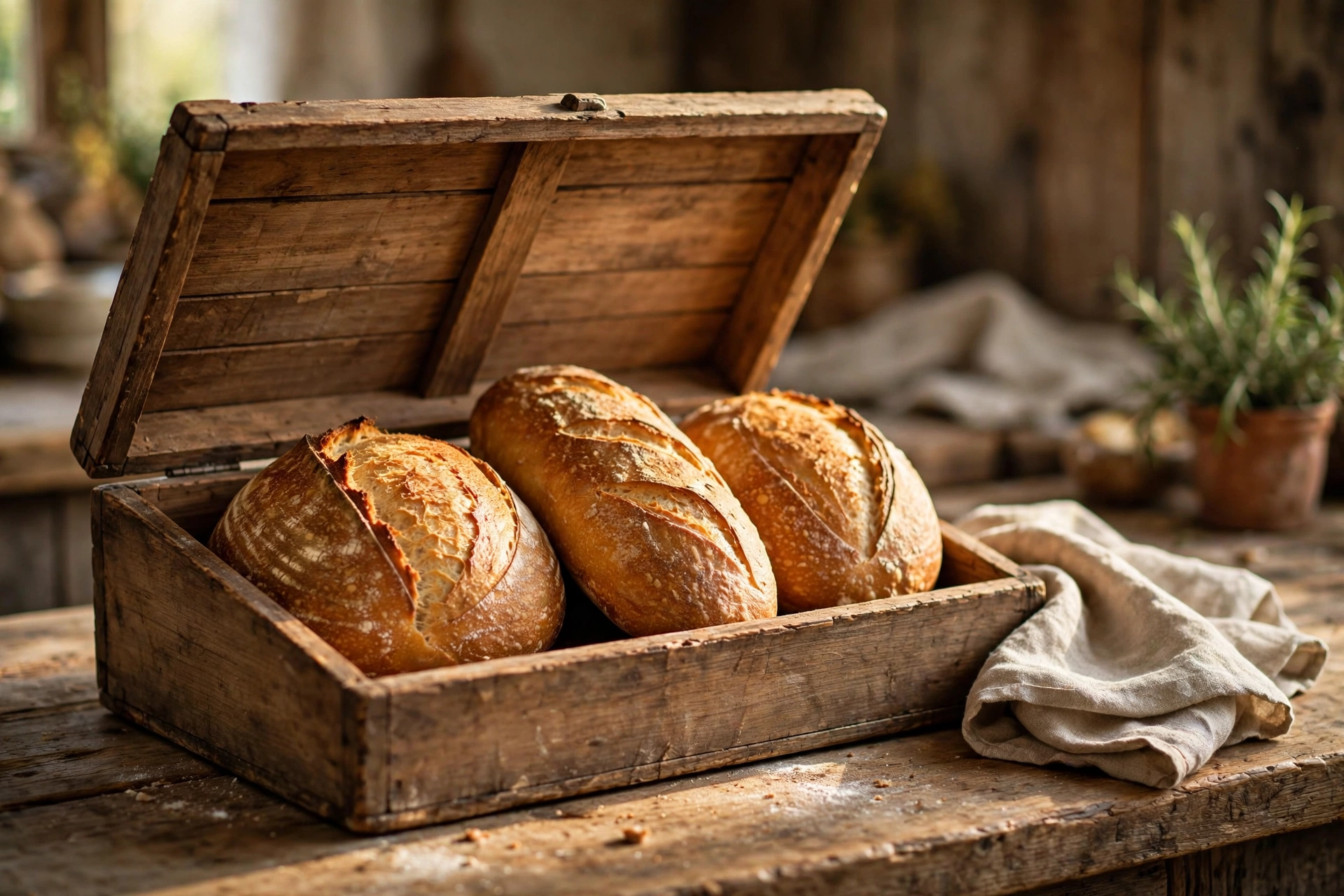
Bread boxes aren’t just retro kitchen decoration — they’re engineered for exactly this job. A good bread box (wood or ceramic, with slight ventilation) creates a microclimate that’s humid enough to keep the crumb soft but dry enough to keep the crust crisp and prevent mold. It’s the Goldilocks zone that plastic bags and open counters can’t match.
I resisted buying one for years because it felt like a single-purpose gadget. Then I got a bamboo one, and my sourdough went from a two-day loaf to a four-day loaf overnight. If you buy bakery bread regularly, a bread box pays for itself in uneaten stale bread within a month. Store the loaf cut-side down inside it (see Tip 2) for the full effect — a bread box is one of the simplest ways to keep bread fresh longer without preservatives.
Tip 4: Choose Linen or Cotton Over Plastic
Your instinct is probably to wrap bread in plastic to “seal in freshness.” For soft sandwich bread, plastic is okay-ish. For crusty artisan loaves, plastic is the enemy — it traps moisture against the crust, turning that beautiful crackle soggy within hours, and the trapped humidity invites mold.
A linen or cotton bread bag is the traditional solution for a reason. The fabric breathes just enough to keep the crust crisp while slowing moisture loss from the crumb. Bakers have used linen couche cloths for centuries; a simple linen bag does the same job in your kitchen. Wrap the loaf in the cloth, then place it in the bread box or a paper bag. No linen bag? A clean cotton tea towel works fine.
Tip 5: Freeze What You Won’t Eat in Two Days
The freezer is the only true long-term solution, and it works brilliantly if you do it right. The key mistake people make is freezing the whole loaf and then thawing the whole thing for two slices. Instead, slice the bread BEFORE freezing. Let the loaf cool completely first — freezing warm bread traps condensation and makes it soggy.
Lay the slices in a single layer on a baking sheet, freeze for an hour (so they don’t stick together), then transfer them to a freezer bag with as much air pressed out as possible. Frozen this way, bread keeps for up to three months. To use, toast slices straight from frozen, or thaw at room temperature for ten minutes. Properly frozen and thawed bread tastes remarkably close to fresh — the freezing process essentially pauses starch retrogradation in its tracks.
Tip 6: Revive Stale Bread in the Oven
Day-three bread that’s gone a bit tough isn’t dead — it’s just waiting for this trick. Run the whole loaf (or the stale portion) under running water for ten to fifteen seconds. Yes, wet the bread. Don’t soak it; just get the crust damp all over. Then put it directly on the oven rack at 300°F (150°C) for ten minutes.
The water turns to steam in the oven, rehydrating the crumb, while the dry heat re-crisps the crust. It comes out shockingly close to fresh-baked — soft inside, crackling outside. This works on baguettes, boules, sourdough, basically any crusty loaf. It won’t save bread that’s actually moldy (when in doubt, throw it out), but for merely stale bread it’s near-miraculous. I’ve served “refreshed” day-old baguettes to guests who assumed they were fresh from the bakery.
Tip 7: Pick Breads That Naturally Last Longer
Not all bread is created equal when it comes to shelf life. Long-fermented breads — sourdough, rye, and anything made with a preferment — stay fresh noticeably longer than quick yeasted loaves. The acidity developed during long fermentation slows starch retrogradation and also inhibits mold. A good sourdough can stay pleasant for five days at room temperature; a standard white sandwich loaf gives you two, maybe three.
Enriched breads last longer too. The fat, sugar, and eggs in brioche, challah, and milk bread lock in moisture. So if you’re choosing between a lean baguette and a sourdough boule at the bakery and you know you won’t finish it today, the sourdough is the smarter buy. This is also why my nutritious breakfast ideas post leans on heartier breads — they survive the week in much better shape.
Tip 8: Don’t Slice Until You’re Ready to Eat
Every slice exposes fresh crumb to the air and starts the staling clock on that surface. If you slice the whole loaf on day one “for convenience,” you’ve just given staling a head start on every single piece. Slice only what you’ll eat right now, and leave the rest of the loaf intact.
This pairs perfectly with Tip 2: slice from the middle when you can, press the two cut faces back together, and store the rejoined loaf cut-side down. It sounds fussy, but it takes three seconds and genuinely extends the loaf’s life. Bakeries do exactly this with their display loaves.
Tip 9: The Paper Bag Inside a Plastic Bag Trick
For the best of both worlds — crisp crust AND moist crumb — use the double-bag method. First put the loaf in a paper bag, which absorbs just enough surface moisture to protect the crust. Then put the paper bag inside a loosely closed plastic bag, which slows overall moisture loss. It’s a clever, no-cost way to keep bread fresh longer without preservatives.
The paper acts as a buffer: it keeps the plastic from making the crust soggy while the plastic keeps the whole package from drying out. It’s not quite as good as a proper bread box, but it’s the best free method I’ve found, and it beats either bag used alone. Replace the paper bag if it gets damp — a soggy paper bag does more harm than good.
The One Thing That Matters Most
If you want to keep bread fresh longer without preservatives, take one thing from this list: keep bread at room temperature and freeze what you won’t eat within two days. That single habit — counter now, freezer for later, never the fridge — solves 90 percent of the staling problem. Everything else is optimization.
I used to lose half of every bakery loaf to the trash or the “I’ll make breadcrumbs someday” bag. Now I lose almost none. The bread box helped, the linen bag helped, but the real change was understanding that staling is a process I can work with instead of a fate I have to accept.
Conclusion
Learning how to keep bread fresh longer without preservatives isn’t about fighting nature — it’s about understanding it. Starch wants to recrystallize; your job is to slow it down with room-temperature storage, smart wrapping, and the freezer for anything beyond a couple of days. Skip the fridge entirely, store cut-side down, and revive what’s gone stale with water and a hot oven.
My Saturday bakery run now stretches comfortably to Wednesday, and the occasional Thursday-morning toast from the freezer tastes like I just bought it. No preservatives, no waste, no brick-hard regrets. Tasting Table breaks down exactly how long fresh bakery bread actually lasts and why — their five-day estimate matches my experience almost exactly.
Buy the good bread. Store it right. Eat it all — now that you know how to keep bread fresh longer without preservatives.