

Last Tuesday I walked away from a pot of rice for “just a minute” to answer the door, and came back to the unmistakable smell of a ruined dinner. The bottom of my favorite stainless steel pot was coated in a black, cement-like crust that laughed at my sponge. My first instinct was to attack […]
Last Tuesday I walked away from a pot of rice for “just a minute” to answer the door, and came back to the unmistakable smell of a ruined dinner. The bottom of my favorite stainless steel pot was coated in a black, cement-like crust that laughed at my sponge. My first instinct was to attack it with steel wool and twenty minutes of elbow grease — the way I’d always done it, the way that always left my arms aching and my pots scratched.
This time I tried something different. I’d read that you can clean burnt pot without scrubbing at all, using nothing but pantry staples and a little patience, and I was skeptical enough to test it properly. Three days of experiments later (don’t ask about the state of my cookware collection), I can tell you it works. The black crust genuinely lifts off with barely any pressure, as long as you let chemistry and heat do the heavy lifting instead of your biceps.
Here’s everything I learned — seven methods, ranked from easiest to most hardcore, plus the mistakes that can actually ruin your pots.
Table of Contents
Why Burnt Food Welds Itself to Your Pot (and How to Clean Burnt Pot Without Scrubbing)
It helps to know what you’re fighting. When food burns onto a pot, the sugars and proteins undergo a reaction that creates a layer of carbon — essentially charcoal — bonded directly to the metal. That bond is strong because the carbon fills the microscopic pores and scratches in the pot’s surface. Scrubbing works by mechanically tearing that bond apart, which is why it’s so much effort.
Every trick below works on the same smarter principle: break the bond chemically or thermally so the crust releases on its own. An alkaline bath (baking soda), an acid (vinegar or lemon), or sustained heat all attack the carbon layer from underneath. Once the bond weakens, a soft sponge is all you need. You’re not skipping the cleaning — you’re outsourcing it to science.
Trick 1: The Baking Soda Simmer (My Go-To Method)
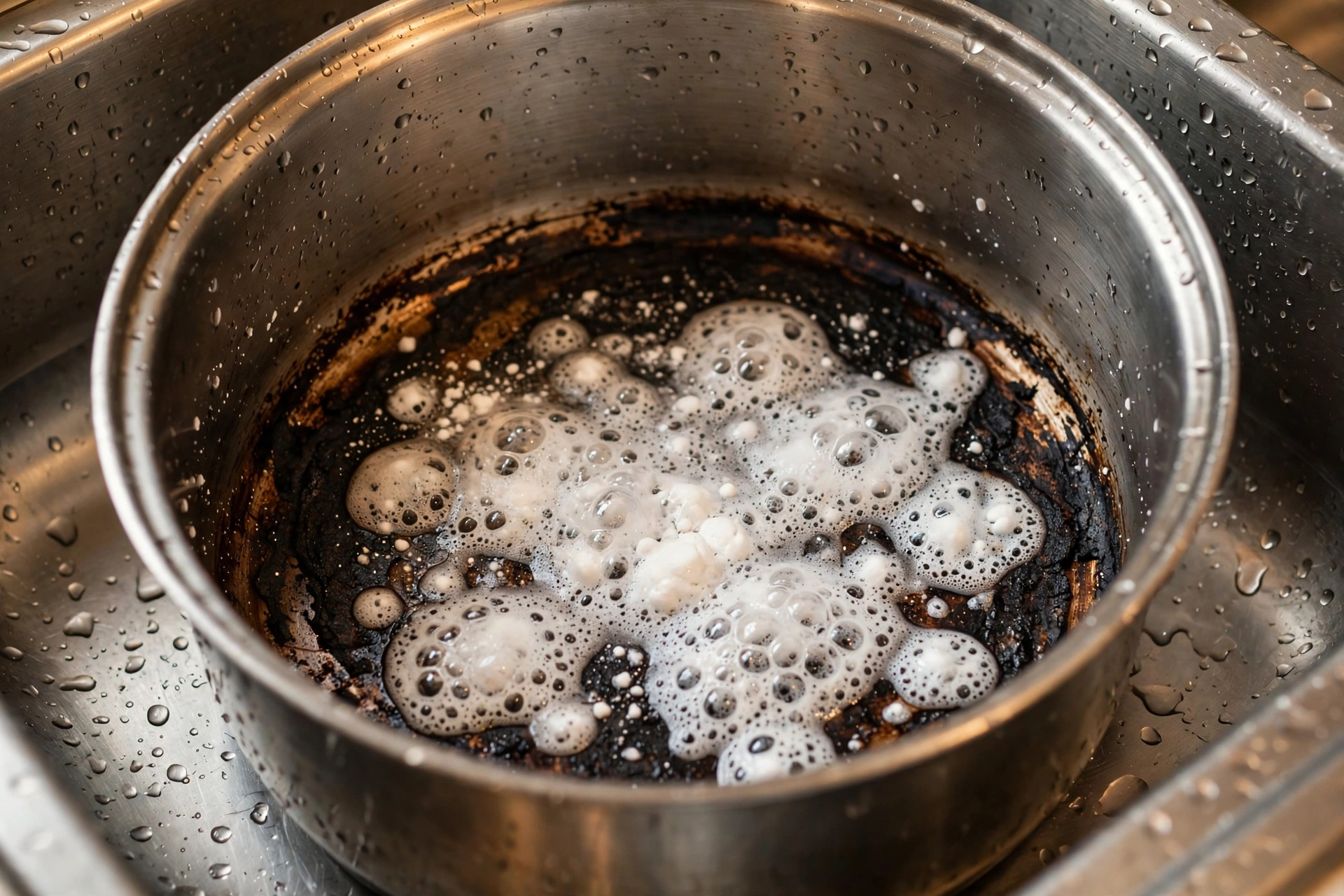
This is the one I use now for almost every burnt pot, and it handles about 80 percent of cases on its own. When friends ask me how to clean burnt pot without scrubbing, this is the method I describe first. Fill the pot with enough water to cover the burnt area by an inch or two. Add two to three tablespoons of baking soda and stir it in. Put the pot on the stove over medium heat and bring it to a gentle simmer — not a rolling boil — for five to eight minutes.
You’ll see dark flakes starting to lift and swirl in the water. That’s the carbon bond breaking. Turn off the heat, let it cool until it’s safe to handle, then pour out the water. Most of the burnt layer will slide off with a soft sponge and a drop of dish soap. For anything still clinging on, sprinkle a little more baking soda directly on the damp surface, wait five minutes, and wipe again.
Why it works: baking soda is mildly alkaline, and that alkalinity softens carbonized food while the simmering heat expands the metal slightly, loosening the crust’s grip. It’s gentle enough for stainless steel, enamel, and most other cookware — which brings me to the important exception I’ll cover in Trick 7.
Trick 2: The Vinegar Boil and Fizz Finish
For thicker, more stubborn crusts, bring out the vinegar. Fill the burnt pot with a mixture of equal parts water and white vinegar, enough to cover the scorched area. Bring it to a boil and let it bubble for five to ten minutes. The acetic acid in vinegar attacks the carbon layer aggressively.
Now here’s the fun part: take the pot off the heat, pour out most of the liquid, and sprinkle two tablespoons of baking soda over the warm, damp bottom. It will fizz dramatically on contact. That fizzing is carbon dioxide being released, and the tiny bubbles physically help lift the loosened crust. Let it sit for ten minutes, then wipe with a soft sponge. The combination of acid soak plus alkaline fizz is a powerhouse way to clean burnt pot without scrubbing, and it handles burns that the baking soda simmer alone can’t.
One caution: never do the vinegar boil in a cast iron skillet. Acid strips the seasoning right off cast iron — I learned this the painful way years ago and had to completely re-season a pan. If you’re dealing with burnt cast iron, stick to the baking soda method and check out my guide on how to season a cast iron skillet for the first time to keep it in good shape afterward.
Trick 3: The Overnight Baking Soda Paste
Some burns are too thick for a quick simmer — the kind where you can barely see metal under the black layer. For those, patience beats heat. Make a thick paste of three parts baking soda to one part water and spread it generously over the burnt area, like frosting a cake. Leave it overnight, or at least eight hours.
In the morning, the paste will have dried into a crust of its own. Add a splash of white vinegar — it’ll fizz — wait five minutes, and wipe everything away with a soft cloth. The long contact time lets the alkalinity work deep into the carbon layer. I’ve rescued pots I was genuinely about to throw away with this method. If you need to clean burnt pot without scrubbing and can plan ahead, this is the most effortless option of all. It takes zero active effort, just patience.
Trick 4: The Dishwasher Tablet Simmer
This one sounds strange until you try it. Fill the burnt pot with water, drop in a single dishwasher tablet (or a tablespoon of dishwasher powder), and bring it to a gentle simmer for ten minutes. Dishwasher detergent is engineered to dissolve baked-on food at high temperatures — it’s essentially a concentrated version of the alkaline attack, with enzymes thrown in.
After simmering, let it cool and soak for another fifteen minutes, then wipe clean. This method is particularly good for enamel-coated Dutch ovens, which can be too delicate for aggressive approaches but handle the dishwasher tablet simmer beautifully. It’s a surprisingly effective way to clean burnt pot without scrubbing delicate enamel. Just rinse thoroughly afterward — you don’t want detergent residue in your next soup.
Trick 5: Salt and Lemon for Light Scorching
Not every burn is a disaster. For light scorching — the brownish film rather than the black crust — you don’t need the heavy artillery. Cut a lemon in half, dip the cut side in coarse salt, and rub it over the scorched area. The salt provides just enough gentle abrasion to lift the film, while the citric acid in the lemon dissolves it.
This is my favorite method for the bottoms of pots that look dull and brownish rather than truly burnt. It takes two minutes, smells wonderful, and the salt is far too soft to scratch stainless steel. Don’t use this on non-stick, though — even gentle abrasives and acids aren’t kind to those coatings over time.
Trick 6: The Celery Boil (Yes, Really)
I thought this was a joke when I first heard it, but the chemistry checks out. Chop up three or four celery stalks, put them in the burnt pot with enough water to cover the damage, and bring it to a boil. Keep it boiling until the black scum starts lifting off and floating to the surface — usually ten to fifteen minutes.
Celery contains natural sodium compounds that create a mildly alkaline broth as it boils, which is the same principle as the baking soda simmer, just weaker and weirder. Is it better than baking soda? Honestly, no. But if you’re out of baking soda and have celery going limp in the crisper drawer, it’s a legitimate rescue. Pour off the murky celery water, wipe the pot, and marvel at how a humble vegetable helped you clean burnt pot without scrubbing.
Trick 7: Know Your Pot — What Works on What
This is the trick that saves you from ruining cookware, so don’t skip it. Different pots need different treatment:
Stainless steel can handle everything above — it’s the toughest and most forgiving. Simmer, boil, paste, all fine.
Enamel-coated cast iron (like Dutch ovens) loves the baking soda simmer and the dishwasher tablet method. Avoid metal tools and harsh abrasives that can chip the enamel.
Non-stick needs the gentlest touch. Use only the baking soda simmer on low heat, never boil vinegar in it (acid degrades the coating), and never use salt scrubs or anything abrasive. Honestly, if a non-stick pan is badly burnt, the coating is probably already damaged — consider replacing it rather than fighting it.
Bare cast iron should never be soaked and never meet vinegar. Use the baking soda simmer only, dry it immediately and thoroughly on the stove, then rub in a thin layer of oil while it’s still warm.
Copper responds well to the salt and lemon method — it’s actually the traditional way to polish copper. Just rinse well afterward.
What NOT to Do to a Burnt Pot
A few things that seem like good ideas but will make your life worse. Never pour cold water into a screaming-hot burnt pot — the thermal shock can warp stainless steel and crack enamel or glass. Let it cool first, or at least use hot water.
Never reach for bleach. It doesn’t dissolve carbon, it can pit stainless steel, and the fumes when heated are genuinely dangerous. Never use steel wool or metal scouring pads on non-stick, enamel, or copper — you’ll trade a burnt pot for a scratched one.
And never put a burnt pot in the dishwasher hoping for the best. The dishwasher can’t reach the temperatures and chemistry needed, and you’ll just bake the crust on harder. Deal with the burn first, then let the dishwasher handle normal washing.
How I Stop Burning Pots in the First Place
After rescuing half my cookware collection, I got serious about prevention. The biggest change: I stopped cooking on higher heat than the recipe needs. Most burning happens because the burner is cranked up “to speed things up” — it doesn’t speed up cooking, it just scorches the bottom. Medium heat and patience produce better food anyway.
Second: I stir starchy foods. Rice, pasta, oatmeal, and anything with sugar needs occasional stirring, especially in the last few minutes. Set a timer if you’re the walk-away type — I am, and the timer has saved more dinners than I can count.
Third: I match the pot to the burner. A small pot on a large burner gets blast-furnace heat around its edges, which is a perfect recipe for scorching. Use a burner that matches the pot’s base.
Finally, a heavy-bottomed pot is worth every penny. Thin pots develop hot spots that burn food even at moderate heat. My thick stainless steel pot — the one from the rice incident — has never burned anything since I learned to respect medium heat.
Conclusion
A burnt pot feels like a small catastrophe in the moment, but once you learn how to clean burnt pot without scrubbing, it becomes one of the most fixable problems in the kitchen. The black crust looks permanent and invincible, yet it surrenders to a simmering pot of baking soda water, a splash of vinegar, or even an overnight paste — no scrubbing, no scratched arms, no ruined cookware.
My simple rule for how to clean burnt pot without scrubbing: start with the baking soda simmer for most burns, escalate to the vinegar boil for stubborn ones, and save the overnight paste for the true disasters. Respect your pot’s material, avoid the mistakes that cause real damage, and you’ll never dread the aftermath of a distracted dinner again. The Kitchn put one popular no-scrub method to the test with honest results — worth a look if you want a second opinion on cleaning a burnt pan without the elbow grease.
Once your pot is back in rotation, keep the rest of your cookware in shape too — here is how to season a cast iron skillet the first time.
My rice pot? It’s back in the rotation, shiny as ever, with no memory of its dark Tuesday. Now that you know how to clean burnt pot without scrubbing, yours will be too.