

I still remember the morning I found one stretched across the hallway ceiling like a tiny eight-legged sheriff, legs splayed wide, absolutely refusing to leave. It was late August, the air had that end-of-summer softness, and I’d gone from half-asleep to fully-alert in about half a second. Not my proudest moment, but honestly? That’s what […]
I still remember the morning I found one stretched across the hallway ceiling like a tiny eight-legged sheriff, legs splayed wide, absolutely refusing to leave. It was late August, the air had that end-of-summer softness, and I’d gone from half-asleep to fully-alert in about half a second. Not my proudest moment, but honestly? That’s what finally made me learn how to keep spiders out of the house naturally instead of just shrieking and hoping for the best.
Because here’s the thing nobody tells you: it’s not random that you start seeing spiders everywhere in late summer and fall. They’re not following you around personally. There’s a real reason it happens, and once you understand the “why,” keeping them out gets a whole lot easier.
This post is everything I’ve learned over the last few years about how to keep spiders out of the house naturally — through trial, error, and a few more ceiling encounters than I’d care to admit. No harsh chemicals, no gimmicky gadgets. Just practical, natural stuff that genuinely made a difference in my home.
Table of Contents
Why Spiders Move Indoors (Especially in Late Summer and Fall)
Spiders follow food and shelter, same as every other creature. During late summer and into fall, two things happen at once. First, the spiders born in spring have grown big enough that you actually notice them — the tiny babies from May are now full-sized adults wandering around. Second, the nights start getting colder, so spiders looking for a warm place to overwinter start pushing indoors.
They’re also following insects. If your porch light pulls in a cloud of moths and flies every night, spiders will set up shop right outside your door, and from there it’s a short trip inside. Spiders don’t want anything from you — they want the bugs. Cut the bug buffet, and a lot of your spider problem quietly resolves itself.
One more thing that surprised me: spiders don’t need a red-carpet invitation. A gap under the front door, a cracked window screen, the hole where a pipe enters under your sink — any of these is a perfectly good spider highway.
Understanding why spiders come inside is the first step in learning how to keep spiders out of the house naturally — once you know what attracts them, you know what to take away.
Seal the Entry Points First
If I could only do one thing on this whole list, it would be this. Every spray and remedy in the world is just a band-aid if spiders have a dozen open doors into your home.
Walk around your house slowly and look for gaps. The usual suspects: cracks in the foundation, worn weatherstripping around doors, torn window screens, and the spots where plumbing or cables enter the house. I found a gap around a dryer vent in my laundry room that was practically a spider turnstile.
The fixes are cheap and straightforward. Door sweeps or draft stoppers on exterior doors close the most common entry point. Replace or patch torn screens — a roll of screen patching material costs almost nothing and takes ten minutes. Around pipes and cables, stuff the gap with copper mesh or steel wool and seal it with caulk; spiders can’t chew through it the way they can foam. Check your foundation for cracks and seal them with masonry caulk.
Do this before anything else on the list, because it’s the single highest-impact change you can make when learning how to keep spiders out of the house naturally, and it works whether you ever buy a single bottle of essential oil or not.
Declutter and Start a Vacuuming Routine
Spiders love clutter the way I love a good used bookstore — the more corners and piles, the happier they are. Basements, attics, garages, under beds, and behind furniture are prime spider real estate because nobody disturbs them there.
You don’t have to become a minimalist. But pick a weekend and deal with the obvious stuff: cardboard boxes stacked on the floor (spiders and insects both love cardboard — switch to sealed plastic bins if you can), piles of laundry, old magazines. Move stored items away from walls a few inches so spiders can’t set up between the box and the wall.
Then start a vacuuming routine. A vacuum with a hose attachment is honestly one of the best spider-control tools you can own — better than most sprays, and it removes the problem physically instead of chemically. Vacuum up webs, spiders, and especially egg sacs. Those little silken balls can hold hundreds of baby spiders, and knocking one down with a vacuum is far better than discovering it after it hatches.
I vacuum baseboards, ceiling corners, under beds, and behind furniture every two weeks during spider season. It takes twenty minutes and it makes an enormous difference — regular vacuuming is one of the most reliable parts of how to keep spiders out of the house naturally. Empty the vacuum outside or into a sealed bag right after, just to be safe.
Change Your Outdoor Lighting
This one is sneakily effective. Outdoor lights attract flying insects, and insects attract spiders — it’s a simple food chain with your porch as the restaurant.
Swap your white porch and floodlight bulbs for yellow or amber “bug light” bulbs. They attract far fewer insects. If you don’t want to change bulbs, just turn the porch light off when you don’t need it, or put it on a motion sensor so it’s only on when someone’s actually at the door.
Also, close your blinds and curtains at night. Spiders and insects can both see interior lights through windows, and a lit window at night is basically a neon “open for dinner” sign to every bug in the yard. This lighting change costs you nothing, works every night on autopilot, and is one of the easiest wins in how to keep spiders out of the house naturally.
Peppermint Oil Spray (The Recipe That Gets Reapplied)
Peppermint oil is probably the most talked-about natural spider repellent, so let’s be honest about it. It’s a popular home remedy that many people swear by, but it’s not a guaranteed force field. The scent seems to bother spiders — they smell through their legs, and strong scents appear to make an area less appealing to them — but the effect fades as the smell fades, which means reapplying regularly.
Here’s the recipe I use: mix 15 to 20 drops of pure peppermint essential oil into a cup of water in a spray bottle, add a tiny squirt of dish soap (it helps the oil mix into the water), and shake well. Spray it around door frames, window sills, baseboards, and corners where you’ve seen spiders. It smells fantastic, which is honestly half the appeal.
Reapply every few days, or after you mop or wipe the area. Keep it away from pets — peppermint oil can be irritating to cats and dogs in concentrated amounts — and don’t spray it on anything the oil might stain. If you came here searching for how to keep spiders out of the house naturally, this recipe is probably what you had in mind — but treat it as a pleasant-smelling supplement to the real work of sealing and decluttering, not the main event.
Vinegar Spray — and Where NOT to Use It
White vinegar is another popular option. The recipe is simple: mix equal parts white vinegar and water in a spray bottle and apply it to window frames, door thresholds, and corners. The sharp smell is unpleasant to spiders (and, let’s be honest, briefly unpleasant to humans too, though it fades fast).
But here’s the important caution: do NOT use vinegar spray on stone surfaces. Vinegar is acidic and it will etch and damage marble, granite, limestone, travertine, and other natural stone — countertops, tile, and thresholds included. Learned this one from a friend’s kitchen counter incident that I’m still not allowed to forget.
Stick to painted wood, glass, and sealed surfaces. And like the peppermint spray, this is a temporary measure — one more short-lived layer in how to keep spiders out of the house naturally. It works for a day or two, then you reapply. It won’t replace sealing entry points or removing the insects spiders are hunting.
Citrus Peels and Other Kitchen Remedies
If you eat oranges, lemons, or limes, you already have a free spider deterrent. Rub fresh citrus peels along window sills, door frames, and bookshelves, or leave peels in little dishes near problem corners. Spiders reportedly dislike the citrus compounds, and your windowsill will smell like a fruit stand for a day.
Is it guaranteed to work? No — like most kitchen remedies, the evidence is mostly anecdotal. But it’s free, it smells nice, and combined with everything else it adds one more mild layer of “this house is not welcoming” to how to keep spiders out of the house naturally. Replace the peels every couple of days before they dry out and stop being useful.
Cedar Blocks, Chips, and Cedarwood Oil
Cedar is one of my favorites on this list because it’s genuinely useful beyond spiders. Cedar blocks and chips naturally contain oils that repel moths and many other insects, and fewer insects means fewer spiders. They last a long time and smell wonderful.
Toss cedar blocks into closets, attics, and storage boxes. Scatter cedar chips around the foundation of your house outside — it doubles as mulch that doesn’t invite pests the way regular mulch can. For indoor use, a few drops of cedarwood oil on cotton balls tucked into corners works similarly to the peppermint spray. Cedar works quietly in the background of how to keep spiders out of the house naturally — and it smells great doing it.
One practical note: cedar’s repellent effect fades as the wood dries out and the scent fades. Lightly sanding a cedar block revives it, which is oddly satisfying.
Diatomaceous Earth (With a Safety Note)
Diatomaceous earth — food-grade — is a fine powder made from fossilized algae, and it works mechanically rather than chemically: the microscopic sharp particles damage the exoskeleton of crawling insects, which dehydrates them. Fewer crawling insects near your home means less food for spiders, which means fewer spiders moving in.
Dust a thin layer along baseboards, under appliances, in cracks and crevices, and around the exterior foundation. A light, barely-visible dusting works better than piles — insects avoid thick piles but walk right through thin layers.
Now the safety note, and please take this seriously: do NOT breathe it in. The fine silica dust is harmful to your lungs. Wear a dust mask when applying it, apply it in thin layers, and keep it away from children and pets. Used carefully and kept dry, it’s one of the more effective tools in how to keep spiders out of the house naturally — just respect the safety rules above. Once it’s settled and undisturbed, it stays put — but don’t use it somewhere the kids or the dog will stir it up. Also, it loses effectiveness when wet, so it’s best in dry indoor spots or dry weather outdoors.
Grow Spider-Repelling Herbs Indoors and Out
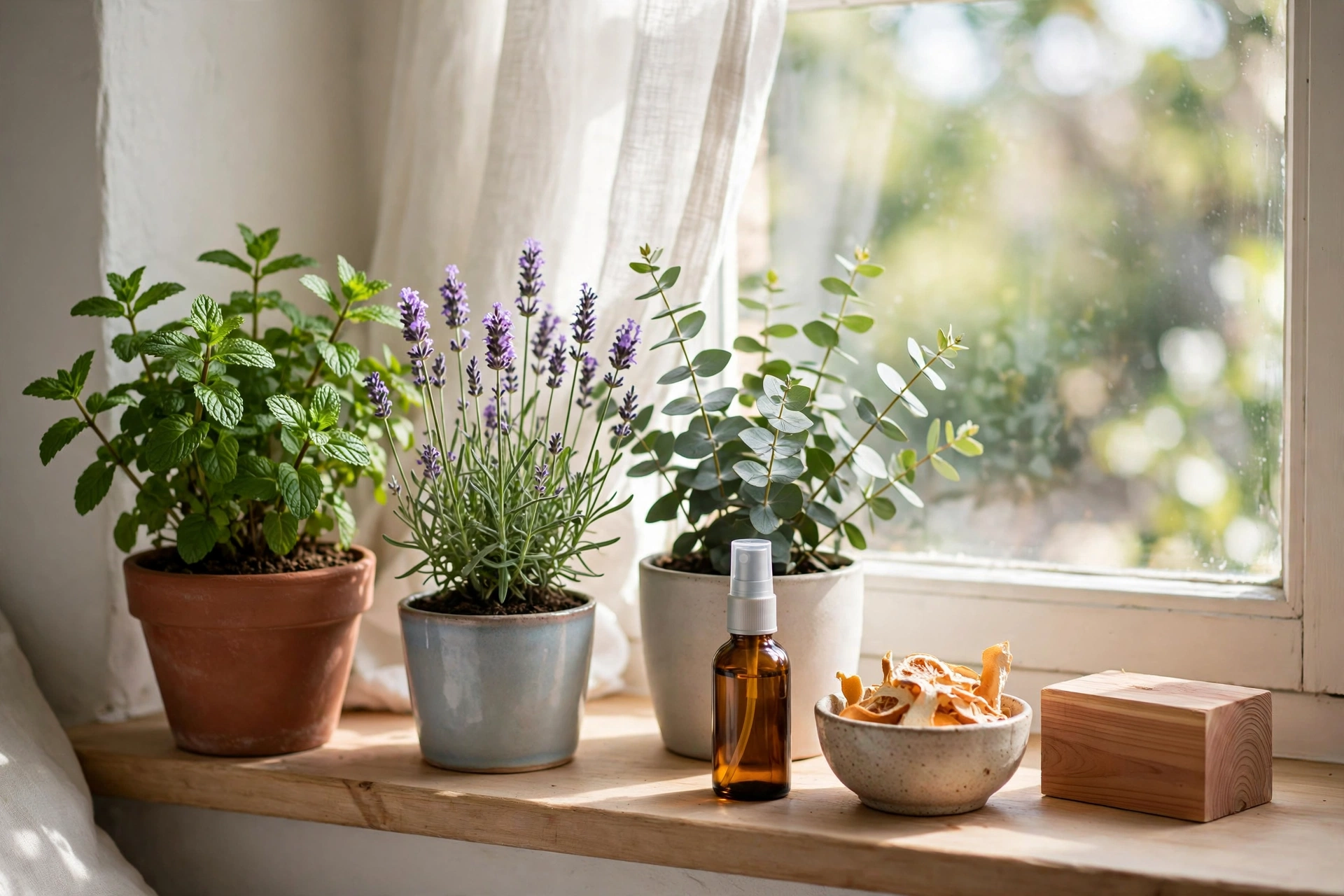
Here’s where you get to be a little bit of a gardener. Several herbs are said to repel spiders — or more precisely, to repel the insects that spiders eat — and they make your home smell lovely in the process. The usual suspects: mint, lavender, eucalyptus, and lemon balm.
Plant mint and lavender around your home’s foundation outside, and keep pots of them near entryways. Indoors, a pot of mint or lavender on a sunny windowsill does double duty as decor and deterrent. Eucalyptus works well in hanging planters. Lemon balm is wonderfully fragrant and easy to grow, though fair warning: mint and lemon balm are both aggressive growers, so keep them in pots unless you want them taking over the garden.
If you’re worried about keeping indoor plants alive, don’t be — some of the easiest houseplants on earth are exactly the kind you want here. I wrote about beginner-proof options in more detail in my post on hard to kill indoor plants for beginners, which is worth a read before you buy anything green. Herbs are the prettiest part of how to keep spiders out of the house naturally — and the only deterrent on this list that doubles as decor.
Try Conkers (Horse Chestnuts)
This one sounds like folklore, and honestly, it might be. The old tradition — particularly popular in the UK — says that placing horse chestnuts (conkers) on windowsills and in corners repels spiders. The theory is that they contain a chemical called saponin that spiders dislike.
Is there solid science behind it? Not really. But conkers are free if you have a horse chestnut tree nearby, they’re harmless, and plenty of people insist it works for them. Place a few on windowsills, along baseboards, and in the corners of rooms where spiders show up. If nothing else, they’re a nice autumn decoration. I’ll put this firmly in the “can’t hurt, might help” corner of how to keep spiders out of the house naturally.
Clear the Outdoor Perimeter
What happens outside your walls determines what tries to come through them. Walk around your house and look at it from a spider’s perspective.
Move firewood at least twenty feet from the house and off the ground — woodpiles are spider condominiums. Rake up leaf piles and clear debris away from the foundation. Pull mulch, ivy, and dense ground cover back a foot or two from the house walls, because spiders love the damp, sheltered habitat that hugging-the-foundation mulch provides. Trim bushes and shrubs so they don’t touch the house; they’re spider bridges straight to your windows and siding. Managing the outdoor perimeter is a big part of how to keep spiders out of the house naturally, because what happens outside your walls determines what tries to come through them.
And knock down webs around the porch, eaves, and windows regularly with a broom or a hose. Every web you destroy forces the spider to spend energy rebuilding instead of settling in — and many will eventually relocate somewhere less annoying. I do a quick web-sweep around the exterior once a week in fall. It takes five minutes.
What Does NOT Work (Being Honest)
I want to be straight with you, because most spider articles are suspiciously optimistic. Here’s what the honest version looks like:
Ultrasonic pest repellers — the little plug-in devices — have no credible evidence behind them for spiders. Skip them.
Essential oil sprays, vinegar, and citrus are temporary at best. The moment the scent fades, so does any effect. They’re pleasant-smelling maintenance, not solutions.
Conkers and chestnuts are unproven. They might help; they might just be decoration. I use them because they can’t hurt, not because I’m confident.
The uncomfortable truth is that no single natural method is a one-and-done fix for how to keep spiders out of the house naturally. Everything on this list needs reapplying, resweeping, or revisiting. If a website promises that one spray will keep spiders away forever, it’s selling something. What actually works is the boring combination: seal the gaps, remove the clutter, cut the insect food supply, and keep at it.
If you’re curious what the science-backed side of this looks like, the Oregon Department of Agriculture published a genuinely useful guide — Reduce Spiders at Home — that covers identification and prevention in a practical, no-hype way. Worth bookmarking.
When to Call a Professional
Most spider situations are a nuisance you can handle yourself. But call a pest control professional if you’re seeing large numbers of spiders consistently despite your efforts, if you find spiders in your bed or clothing repeatedly, or if you suspect venomous species — in the US that mainly means black widows and brown recluses; know what they look like in your region.
Also call if you find lots of egg sacs, which signals an established population rather than a few wanderers, or if spiders are a symptom of a bigger problem like a serious insect infestation or moisture issues. A professional can identify entry points you missed and treat the underlying insect population that’s feeding the spiders. There’s no shame in it — I did it once when a damp basement was clearly beyond the DIY stage, and it was worth every penny.
The Bottom Line
Learning how to keep spiders out of the house naturally isn’t really about any single trick. It’s a system: seal the entry points so they can’t get in, declutter and vacuum so the ones inside can’t settle, cut the outdoor insect supply so they’re not drawn to your home in the first place, and layer on the pleasant natural deterrents — peppermint, cedar, herbs, citrus — as maintenance.
Start with sealing, because that’s the foundation everything else builds on. Then pick two or three of the natural methods that appeal to you and actually stick with them through spider season. You won’t get to zero spiders — and honestly, a house with zero spiders isn’t a realistic goal — but you can absolutely get from “spider in every corner” to “oh, there’s one in the garage sometimes,” and that feels like a victory worth celebrating.


2 Comments