

I have a confession: for years, buying a houseplant felt like signing its death warrant. I’d bring home a gorgeous fern, place it proudly on my bookshelf, and within six weeks it would be a crispy brown memorial to my good intentions. I killed succulents. Succulents! The plants that are supposed to survive anything. Then […]
I have a confession: for years, buying a houseplant felt like signing its death warrant. I’d bring home a gorgeous fern, place it proudly on my bookshelf, and within six weeks it would be a crispy brown memorial to my good intentions. I killed succulents. Succulents! The plants that are supposed to survive anything.
Table of Contents
Then a friend who’s basically a plant whisperer told me something that changed everything: “You’re not bad with plants. You’re just buying the wrong plants.”
She was right. Once I switched to hard to kill indoor plants for beginners — the genuinely tough, forgiving species instead of the finicky Instagram-famous ones — my home slowly turned into a little jungle. Three years later, every plant on this list is still alive in my house, and several have multiplied into gifts for friends. If I can keep these alive, trust me, you can too.
Why Hard to Kill Indoor Plants for Beginners Changed Everything for Me
Here’s the thing nobody tells you when you’re starting out: most houseplant advice is written for people who already know what they’re doing. “Bright indirect light,” they say, as if that’s a precise measurement. “Water when the top inch of soil is dry,” they say, assuming you know what dry soil feels like versus slightly damp soil.
Beginner-proof plants sidestep all of that. They don’t care if your apartment faces north. They don’t care if you forget to water them for two weeks while you’re on holiday. They don’t care if your heating runs hot in winter and your air is bone dry. They just quietly grow, asking almost nothing in return.
The psychological effect surprised me most. Keeping one plant alive for a year gave me the confidence to try a second, then a third. Now I genuinely enjoy the little rituals of plant care — but I never would have gotten here if I’d started with a calathea or a fiddle-leaf fig. Start with the survivors. The divas can wait.
My Shortlist of Hard to Kill Indoor Plants for Beginners
Every plant below earned its spot by surviving my actual home: a flat with mediocre light, inconsistent watering, and a cat who occasionally bats at leaves. I bought each of these as a small, cheap plant from an ordinary garden centre — nothing exotic, nothing over £15.
Snake Plant — The One That Survived My Two-Week Holiday
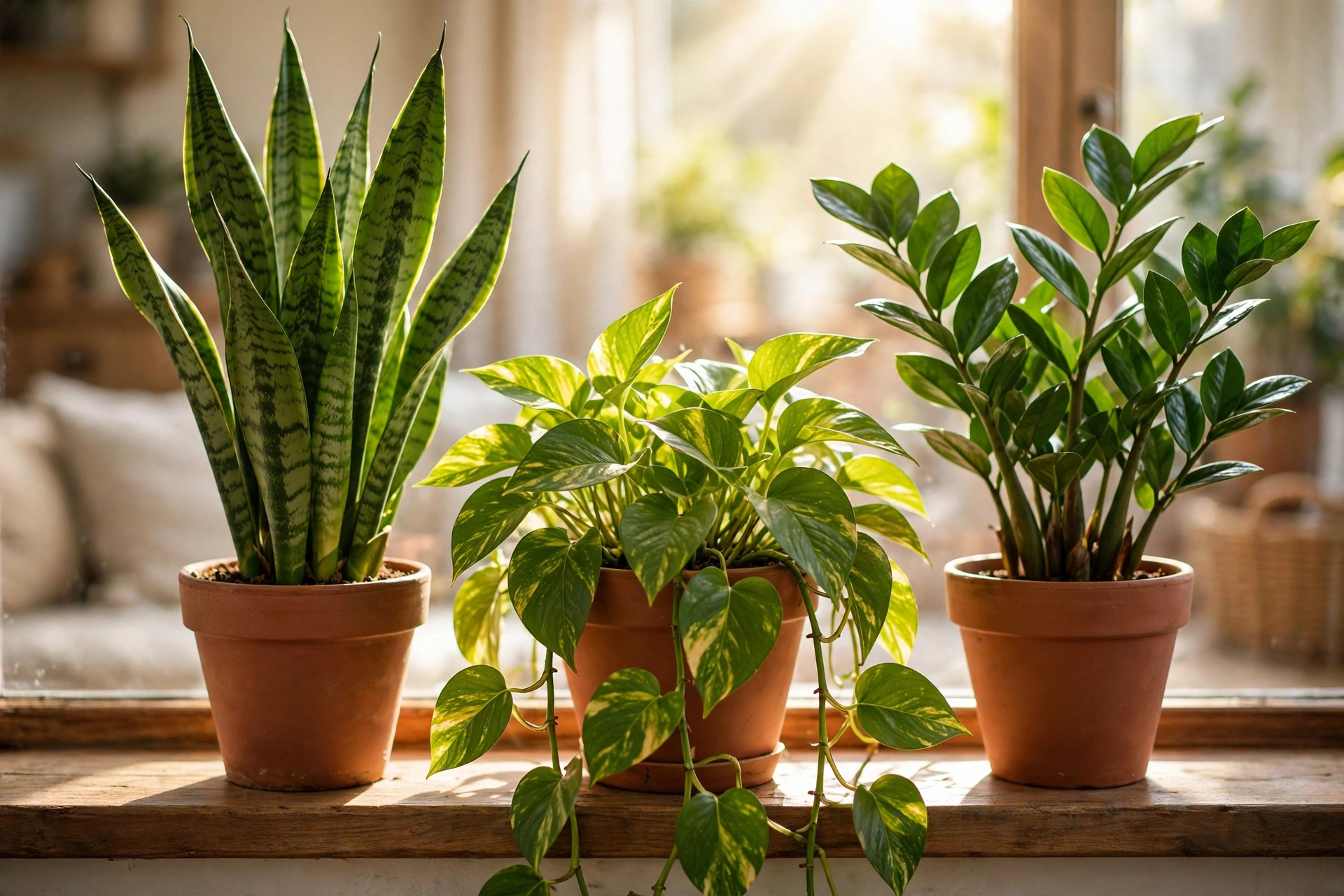
The snake plant (Sansevieria, though botanists recently renamed it Dracaena — nobody in real life calls it that) is the undisputed champion of hard to kill indoor plants for beginners. Mine sat in a dim hallway for a month while I was away, completely unwatered, and when I came home it looked exactly the same. Possibly better. I think it enjoyed the solitude.
Those tall, sword-shaped leaves aren’t just handsome in a modern, architectural way — they’re water tanks. The plant stores moisture in its thick leaves, which is why it shrugs off forgotten waterings. It tolerates low light, bright light, dry air, and just about everything except one thing: soggy soil. Water it only when the soil is completely dry, maybe every two to three weeks, and give it a pot with drainage holes. That’s the entire care manual.
One honest warning: it’s mildly toxic if chewed, so if you have a determined plant-eating pet, put it somewhere they can’t reach. Mine lives on a high shelf where the cat can’t launch an expedition to it.
ZZ Plant — The Glossy One That Thrives on Neglect
The ZZ plant looks like it belongs in a design magazine — glossy, dark green leaflets arranged in perfect symmetry along arching stems — and yet it asks for almost nothing. It stores water in thick underground rhizomes (basically potato-like lumps under the soil), so it can go weeks, even a month, without water and not blink.
What I love about the ZZ is how clearly it communicates. When it’s thirsty, the leaflets lose a tiny bit of their gloss and the stems feel slightly softer. Water it, and within a day it’s back to looking freshly polished. There’s no guessing, no drama.
It tolerates low light better than almost any other common houseplant, which makes it perfect for that sad corner of your living room where nothing else survives. Growth is slow — don’t panic if yours doesn’t seem to do much for months. It’s building those rhizomes underground, saving up for a growth spurt.
Golden Pothos — The Fast Grower That Forgives Everything
If you want quick results, golden pothos is your plant. I bought a small one in spring, and by autumn its trailing vines were spilling off the bookshelf and nearly touching the floor. Few things are as satisfying for a beginner as a plant that visibly grows.
Pothos is almost absurdly adaptable. Low light? It grows (a bit slower, with less variegation). Bright indirect light? It grows faster. Forgot to water it? The leaves droop dramatically, like it’s staging a protest — then perk right back up within hours of watering. It’s the only plant I own that tells me exactly what it needs, in real time.
It also propagates effortlessly, which is how mine became three plants. Snip a stem just below a leaf node (those little brown bumps on the vine), stick it in a glass of water, and within two weeks you’ll see roots. Free plants forever. I now give rooted cuttings to friends in jam jars, which makes me feel like a proper plant person.
Spider Plant — The One That Makes Free Baby Plants
The spider plant has been around forever — your grandmother probably had one — and there’s a reason it never went out of style. It’s tough, cheerful, and endlessly generous: healthy spider plants constantly produce arching stems tipped with tiny baby plants, called plantlets, that dangle like green fireworks.
Those babies are absurdly easy to turn into new plants. You can snip one off and pot it up, or just leave it attached to the mother plant until it grows little roots, then separate it. I started with one spider plant two years ago; I now have five, and I’ve given away at least four more.
Care is straightforward: bright indirect light keeps the white stripes crisp, and it likes a drink when the top inch or two of soil dries out. Brown leaf tips are the classic spider plant complaint — usually caused by fluoride in tap water or letting it dry out too long. Neither kills the plant; it’s cosmetic. If the tips bother you, switch to filtered water or let your tap water sit out overnight before using it.
Cast Iron Plant — The One That Lives Up to Its Name
The cast iron plant (Aspidistra) got its common name in Victorian times, when it survived gas lighting, coal dust, draughts, and general neglect in parlours that would kill lesser plants. It’s not the flashiest plant — broad, deep-green leaves rising straight from the soil — but it is possibly the toughest houseplant on this list.
Mine lives in the darkest corner of my bedroom, a spot where I’ve killed two other plants (rest in peace, little fern). The cast iron plant hasn’t just survived there; it slowly, steadily puts out new leaves every few months. It tolerates deep shade, temperature swings, missed waterings, and dry air without complaint.
Growth is glacial, so buy the size you want it to be rather than hoping it’ll fill out quickly. And honestly? There’s something calming about a plant that simply exists, green and unbothered, asking nothing of you. Not every plant needs to be a project.
Jade Plant — The Succulent That Actually Likes You
After killing several succulents early on (overwatering — always overwatering), I was nervous about trying again. But the jade plant is the succulent for people who’ve killed succulents. Its thick, oval leaves store so much water that it genuinely prefers being left alone.
Here’s the trick that finally worked for me: water it deeply, then don’t touch it again until the soil is bone dry all the way through. In winter, that might mean watering once a month or even less. The leaves will tell you if you’ve gone too far — they’ll get slightly wrinkly and soft when truly thirsty, then plump back up after a drink.
Jade plants also live practically forever and can grow into impressive little trees over the years. Mine is still small, but my aunt has one that’s older than I am, passed down from her mother. There’s something lovely about a plant that can outlive its owner. Give it your sunniest windowsill and a gritty, fast-draining soil mix, and it’ll reward benign neglect with decades of growth.
Heartleaf Philodendron — The Trailing Beauty for Dark Corners
The heartleaf philodendron is pothos’s slightly more elegant cousin — heart-shaped leaves in deep green, trailing or climbing depending on how you train it. If your flat is short on natural light, this is the plant to get: it genuinely tolerates low-light conditions that would make most plants sulk.
Care is nearly identical to pothos: water when the top couple of inches of soil dry out, and it’ll forgive the occasional lapse either way. It also propagates the same way — snip below a node, root in water, pot up. Between this and the pothos, you could fill a whole flat with trailing greenery for the price of two small starter plants.
One thing to know: like several plants on this list, it’s toxic if eaten, so keep it away from curious pets and small children. Hanging planters or high shelves solve this neatly, and trailing plants look best up high anyway.
The 5 Mistakes That Kill Most Beginner Houseplants
Having talked to plenty of fellow reformed plant-killers, I’ve noticed we all made the same handful of mistakes. Avoid these and your survival rate will skyrocket:
1. Watering on a schedule instead of checking the soil. “Water every Sunday” sounds responsible, but plants don’t drink on timetables. In winter they need far less; in a heatwave, far more. Always check the soil first — which brings me to the finger test below.
2. No drainage holes. This is the silent killer. A beautiful ceramic pot with no hole in the bottom turns into a swamp, roots rot, and the plant dies while the soil surface looks perfectly fine. Either use pots with drainage holes or keep the plant in its plastic nursery pot and set that inside the decorative one.
3. Repotting into a giant pot. It feels generous, but a tiny plant in a huge pot sits in wet soil it can’t drink fast enough — see mistake number two. Go up only one pot size at a time.
4. Putting a low-light plant in a dark corner — or a bright-light plant in direct scorching sun. “Low light tolerant” doesn’t mean “no light.” Even the toughest plants need some ambient daylight. And that “bright” plant will fry on a south-facing windowsill in July without acclimatisation.
5. Fussing too much. Moving the plant around daily, misting obsessively, fertilising every week, repotting at the first sign of anything — plants hate instability. Pick a decent spot, water when needed, and otherwise leave it alone. Benign neglect beats anxious overcare almost every time.
My Dead-Simple Watering Routine (The Finger Test)
Forget schedules. Here’s the only watering method I’ve used for three years: stick your finger about an inch or two into the soil. If it feels damp, walk away. If it feels dry, water thoroughly until water runs out of the drainage holes, then empty the saucer so the pot isn’t sitting in water.
That’s it. It takes five seconds per plant, once or twice a week. The finger test works because it measures what the plant actually experiences — soil moisture at root level — instead of guessing from the surface, which dries out much faster.
In winter, when growth slows and the air is cooler, you’ll find yourself watering far less often. In summer, more. The finger test adjusts automatically, which is exactly why it beats any fixed schedule. If you want to level up your knowledge later, the Royal Horticultural Society’s houseplant growing guide is the most trustworthy free resource I’ve found — it’s written by actual horticulturists, not content farms. You’ll find it here: the Royal Horticultural Society’s houseplant growing guide.
What You Actually Need to Buy (It’s a Short List)
Beginner plant care has been wildly overcomplicated by shops that want to sell you things. Here’s my honest starter kit, total cost under £30:
- The plant itself — start with ONE, not seven. A small snake plant or pothos, £8-12.
- A pot with drainage holes — terracotta is cheap, breathable, and looks great.
- Decent potting mix — any standard houseplant compost works for everything on this list (jade prefers a cactus/succulent mix, but standard compost with extra perlite does fine).
- A watering can with a narrow spout — precision beats drowning.
That’s genuinely it. No misting bottles, no moisture meters, no special fertilisers (a half-strength feed once a month in spring and summer is plenty, and even that’s optional the first year). Master the basics with one plant, and you’ll know exactly what you want when you’re ready for more.
Start With Just One — Then Watch What Happens
If you take one thing from this guide, let it be this: your past plant failures weren’t a character flaw. You were probably watering too much, using pots without drainage, or — like me — buying beautiful but demanding plants before you’d learned the basics. Switching to hard to kill indoor plants for beginners removes all of that pressure.
Pick one plant from this list. Just one. Put it somewhere you’ll see it every day, learn its little signals, and give yourself permission to be imperfect. In six months, when it’s still alive and maybe even growing, you’ll understand why people get obsessed with this hobby. And when you’re ready to expand, you might even try growing a few herbs for the kitchen — there’s nothing like snipping fresh basil onto your eggs in the morning, and my roundup of nutritious breakfast ideas has plenty of ways to use them.
Welcome to the club, fellow plant person. Your windowsills are about to get a lot more interesting.


3 Comments