

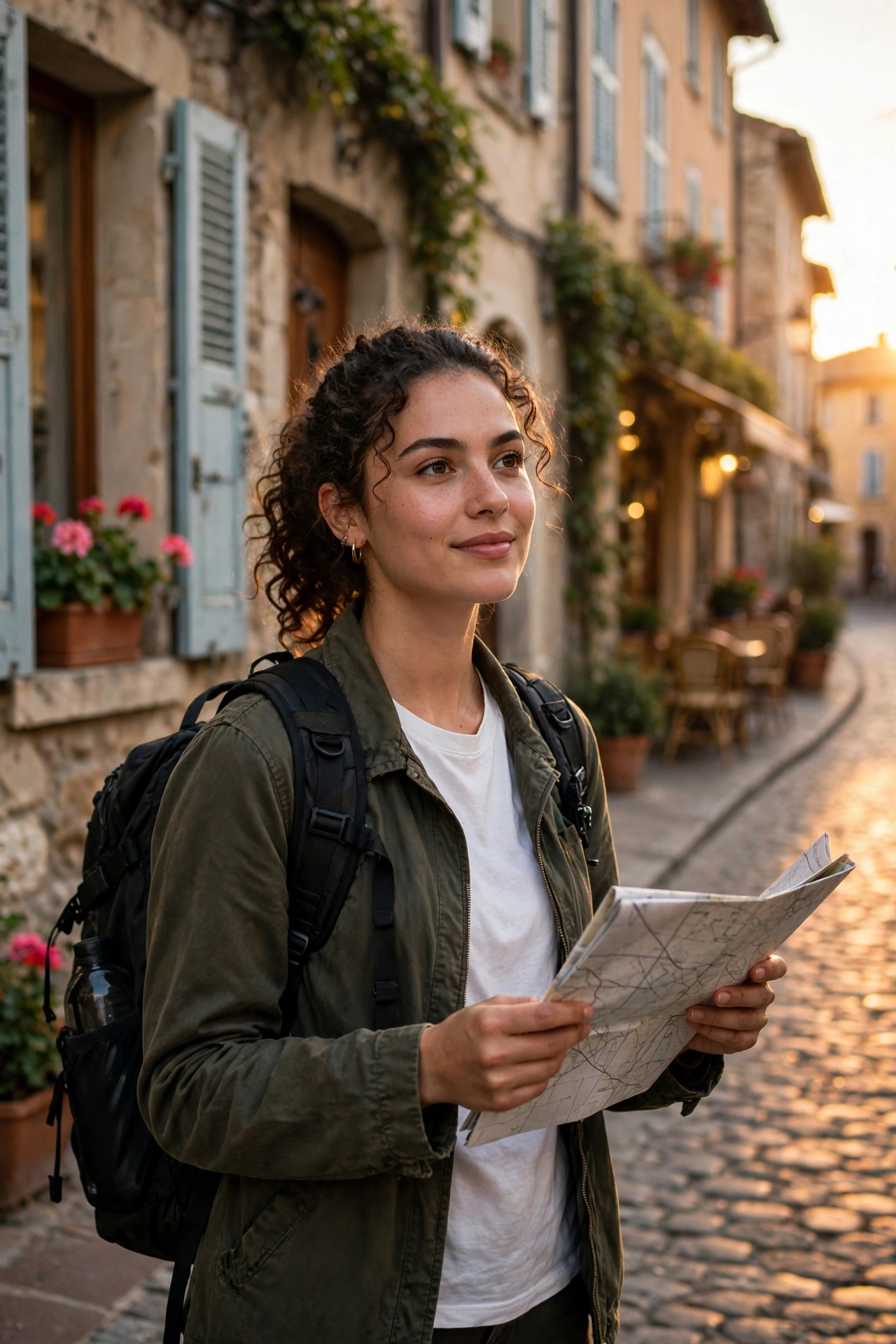
I sat on my bedroom floor next to a half-packed backpack, a printed hostel confirmation, and about forty open browser tabs — and I was this close to canceling the whole thing. Not because I didn’t want to go. Because I was scared in that quiet, specific way that feels embarrassing to admit. What if […]
I sat on my bedroom floor next to a half-packed backpack, a printed hostel confirmation, and about forty open browser tabs — and I was this close to canceling the whole thing. Not because I didn’t want to go. Because I was scared in that quiet, specific way that feels embarrassing to admit. What if I got lost somewhere my phone didn’t work? What if I picked the wrong neighborhood?
Here’s what I wish someone had told me that night: that fear is not a sign you’re not ready. It’s a sign you’re thinking things through, which is exactly what makes a woman good at traveling alone. These solo travel safety tips for women come from years of figuring it out on the road — the good decisions, the sketchy near-misses, and the small habits that make all the difference on a first trip.
Table of Contents
Why Solo Travel Safety Tips for Women Feel So Different
Let’s be honest about what most generic travel guides skip: traveling alone as a woman genuinely involves a different risk calculus. It’s not fair, and it’s not your fault, but pretending otherwise doesn’t keep anyone safe. On my second trip, a friendly stranger at a night market offered to walk me “the safe way” back to my guesthouse — and every instinct in my body said no while my politeness said maybe. I went with my instincts, and I’ve trusted that feeling ever since.
The worry first-timers feel usually falls into three buckets: fear of crime, fear of getting lost or stranded, and fear of being judged for eating alone or looking lost. The first two are solved with planning and habits. The third dissolves on its own around day three, when you realize nobody is watching you — everyone’s busy living their own trip. The anxiety you’re feeling right now is the heaviest it will ever be. It gets lighter with every mile.
Planning and Research Before You Go
The safest solo trip is mostly planned before you leave your house. I start with what I call the boring work. Read recent posts from women who’ve been where you’re going — the honest write-ups describing which neighborhoods felt comfortable after dark. Skim government travel advisories too, but fellow travelers’ reports are far more useful for day-to-day reality.
Learn the local scams before you go, not after you fall for one. Every destination has its classics: the taxi with the “broken meter,” the friendly local who insists your hotel is closed, the distraction-and-pickpocket routine at crowded sights. When you already know the playbook, you can smile and walk away instead of freezing. I also save offline maps of the whole city before I fly, download the local language into a translation app, and write my embassy’s address and number in a notebook. Paper backup matters — phones die at the worst moments.
And always tell at least two people your full itinerary: flights, accommodation addresses, dates in each place. It’s a five-minute email that buys enormous peace of mind.
Choosing Safe Accommodation as a Solo Woman Traveler
Where you sleep matters more than almost any other decision. I’ve stayed in everything from five-star hotels to twelve-bed dorms, and the price tag isn’t what makes a place safe. What matters is the neighborhood, the security setup, and reviews from other women.
Filter reviews for solo female travelers and read what they wrote, not just the star rating. Look for 24-hour reception, key-card floor access, and well-lit entrances. Avoid ground-floor rooms when you can, and check the door has a working lock plus a secondary latch. Hostels with female-only dorms are wonderful for first-timers — built-in company at breakfast and people to swap plans with.
Location beats luxury every time. A modest guesthouse on a busy, well-lit street where shops stay open late will feel — and be — safer than a fancy hotel down a deserted road. Check street-view images around any place you’re considering and note what time nearby restaurants close. On arrival, learn the fire exits and save the address in your phone in the local language so you can show it to any driver.
Pack a sleep mask and earplugs, because unfamiliar noises in a new room are the number-one sleep killer. And bring a travel pillow that actually supports your neck — I spent one miserable sightseeing day waking up with a stiff neck thanks to a terrible hostel pillow. Being rested and alert is a safety strategy, not a luxury.
Transport Safety: Arrivals, Rideshares, and Night Travel
Arrivals are the most vulnerable moment of any trip. You’re tired, disoriented, carrying everything you own. I plan arrivals carefully now: airport pickup through my accommodation when possible, or research beforehand on the official taxi rank, fair prices, and rideshare pickup zones.
For rideshares and taxis, the rules are non-negotiable. Sit in the back seat. Share your trip through the app so someone can follow your route. Confirm the license plate and driver photo before you get in. Keep your map open so you’d notice a route deviation. And trust your gut at the curb — if a driver makes you uncomfortable, cancel. The fee is always worth it.
I try to arrive in new cities during daylight — it makes finding accommodation and reading signs ten times easier. For unavoidable night travel, I pick sleeper trains or buses with solid reviews over the cheapest option, keep valuables on my body, and sit near other women or families. On night buses, I loop my daypack strap around my leg so I can actually rest instead of half-sleeping with one eye open.
Packing for Safety: Gear, Documents, and Backups
You don’t need tactical gear — you need boring, practical stuff. A doorstop alarm is the best ten dollars I’ve spent on travel: it wedges under any door and screeches if someone pushes it open. I also carry a small combination padlock for hostel lockers and a neck pouch for my passport, backup card, and emergency cash on transit days.
Give documents a system. Passport stays locked up; carry a photocopy plus a phone photo for daily ID. Before every trip, I email myself scans of passport, insurance, flights, and bookings, and share that email with my emergency contact. If everything gets stolen — it happened to a friend in Barcelona — you rebuild from that email, not from memory.
Keep a portable charger charged; a dead phone in an unfamiliar city at night is the closest most of us get to a real emergency. Add a headlamp for dark dorms, and keep small-denomination local cash separate from your main wallet so you’re never flashing a full wallet at a market stall.
Longer trips get easier — and safer — when money isn’t forcing you into the cheapest option. Plenty of women I know fund their travels with a side hustle so a tight budget never decides their accommodation for them. A financial cushion is a safety strategy too.
Staying Connected: Location Sharing and Check-Ins
Solo doesn’t have to mean silent. The most confident solo travelers I know are also the most communicative about where they are. I share my live location with a trusted person whenever I head somewhere unfamiliar, and I keep a simple check-in rhythm: a good-morning and a goodnight message, every day, no exceptions. Miss one, and my person follows up.
Before day trips or hikes, send someone the plan — where you’re going, who you’re with if anyone, when you’ll be back. Thirty seconds of typing means someone would notice if something went wrong. I also keep a paper card in my daypack with my accommodation address, emergency contact, and medical info, in case my phone is lost or dead when I need help most.
One social media habit: I post trip photos after I’ve left the location, not in real time. Announcing “here I am alone at this beach right now” to the internet is an invitation nobody needs. Share the memories — just share them on a delay.
For official, up-to-date country guidance, I also check the U.S. State Department’s travel safety guidance before finalizing any itinerary.
Street Smarts and Trusting Your Instincts
The goal on the street is simple: look like you know where you’re going, even when you don’t. Walk with purpose, head up, and check your map inside a café rather than spinning around on a corner. I dress a notch more conservatively than at home, following local norms — not about fairness, about not drawing the attention that makes you a target. Flashy jewelry stays home; my travel look is deliberately unremarkable.
Your instincts are a safety tool, not a character flaw. If something feels off — the empty train car, the overly persistent “guide,” the street that suddenly goes quiet — act immediately. Duck into a shop. Cross the road. Turn around. You never owe a stranger your time, your smile, or an explanation. “No” is a complete sentence in every language.
Daily habits I never skip: bag zipped and in front of me in crowds, phone never in a back pocket, only day essentials on me with the rest locked up. Use ATMs inside banks during the day. And never follow a stranger to a second location, no matter how friendly the invitation. Public places only, always.
Eating and Going Out Alone, Confidently
This is the part first-timers dread and veterans love most. My system for the first dinner in a new city: a busy, well-reviewed spot, plus a book or journal. Having something to do with your hands dissolves the self-consciousness. By night three, you’ll be people-watching like a local and ordering the weird thing on the menu.
Evenings need tighter rules. Research nightlife like neighborhoods — where do locals go, which areas get sketchy after midnight? Never leave a drink unattended, never accept one you didn’t watch being poured. Stay in populated areas, and plan your route home before you go out: saved address, charged phone, transport confirmed. For daytime exploring, make lunch your big adventurous meal — restaurants are lively, everything’s cheaper, and you’re back well before dark if you want a quiet evening.
Common Scams to Watch For
Forewarned is forearmed. The classics: the “helpful local” who says your hotel is closed and steers you to a cousin’s shop. The spilled-something distraction while an accomplice lifts your bag. The bracelet pressed into your hand, then aggressive demands for payment. The fake petition on a busy street.
The defense is almost always the same: a firm no, no eye contact with the pitch, keep walking. Scammers target hesitation, so decisiveness is your armor. Don’t feel rude — they’re running a script, and your politeness is the vulnerability they’re counting on. I never let anyone “help” with luggage at stations unless they’re uniformed staff, and I count change carefully in markets and taxis.
One scam targets women specifically: overly friendly strangers inviting you for tea or a “local experience” that ends in an outrageous bill you’re pressured to split. Genuine hospitality exists and it’s beautiful — but genuine hosts don’t materialize on tourist streets with a laminated menu. Meet people through hostels, tours, and cooking classes instead, where everyone’s intentions are clear.
Pre-Trip Safety Checklist
Don’t keep the plan in your head — write it down:
- Share your full itinerary with two people: flights, addresses, dates per city
- Save offline maps, translation app, and embassy contacts on your phone
- Email yourself scans of passport, insurance, and bookings; share with your emergency contact
- Research local scams, safe neighborhoods, and official taxi/rideshare options
- Book accommodation with 24-hour reception and strong reviews from solo women, on a lively street
- Pack: doorstop alarm, padlock, portable charger, headlamp, document copies, small-denomination cash
- Set up location sharing and a daily check-in routine with someone at home
- Arrange arrival transport in advance; aim to land during daylight
- Learn key phrases: no, help, police, hospital, how much
- Confirm travel insurance covers your activities, including medical evacuation
Run through it a week before you fly, not the night before. Future you, standing in the arrivals hall with everything under control, will be grateful.
Conclusion
Here’s the truth nobody tells first-timers: you don’t become brave and then travel solo. You travel solo and the bravery shows up along the way — somewhere between navigating your first foreign metro and the evening you realize you just had the best meal of your life at a table for one. Every one of these solo travel safety tips for women is really about the same thing: replacing vague fear with specific preparation, so the only surprises left are the good ones.
Start smaller if you need to — a weekend in a city where you speak the language counts. There’s no purity test here — just you, a ticket, and the version of yourself waiting on the other side of the departure gate. She’s more capable than you think. Go find out.


3 Comments