

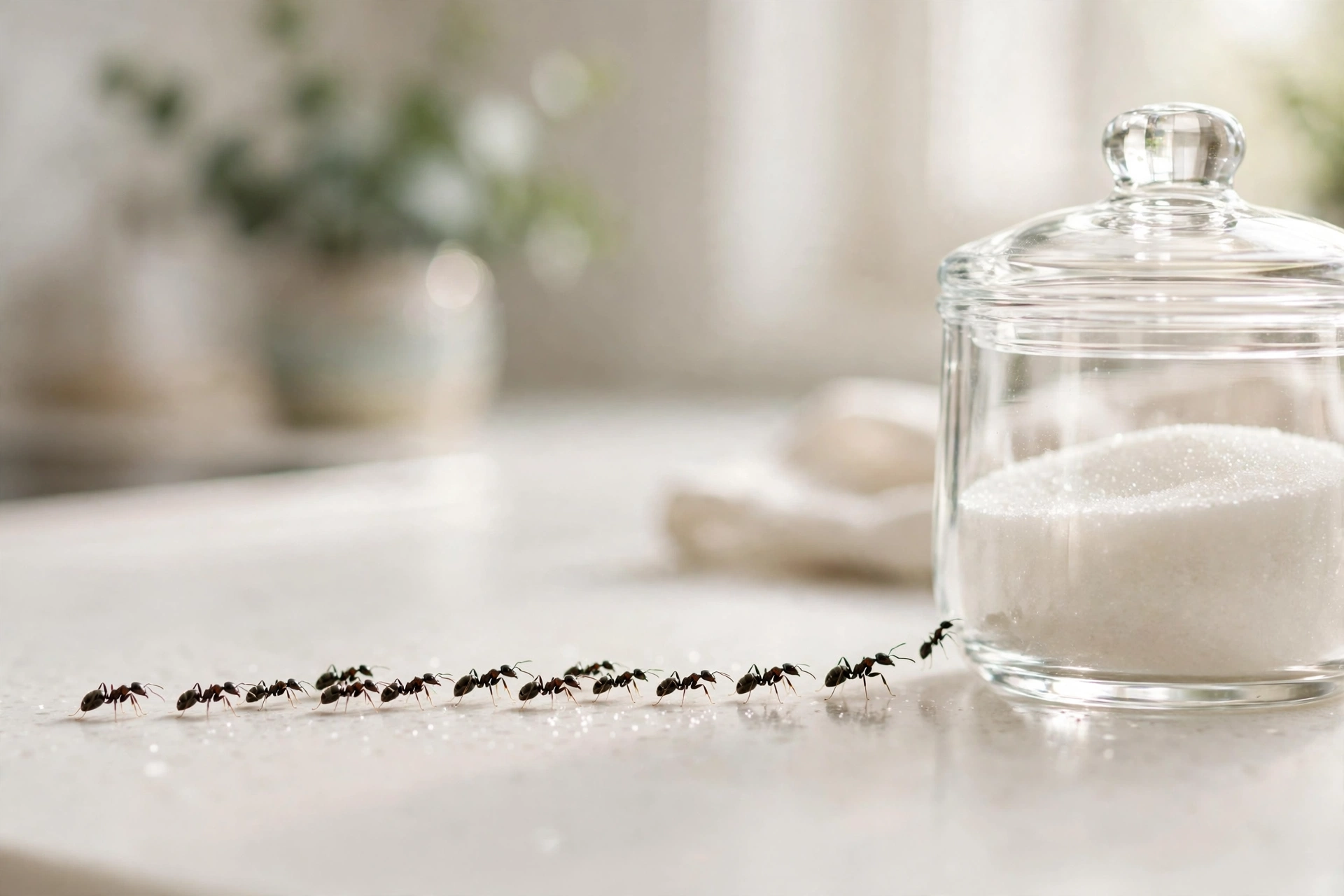
It always starts the same way. You walk into the kitchen in the morning, half asleep, and there’s a thin black line marching across your counter — straight to the sugar bowl, the fruit basket, or that one crumb you somehow missed last night. One ant is an annoyance. A trail of fifty is a […]
It always starts the same way. You walk into the kitchen in the morning, half asleep, and there’s a thin black line marching across your counter — straight to the sugar bowl, the fruit basket, or that one crumb you somehow missed last night. One ant is an annoyance. A trail of fifty is a declaration of war.
I’ve fought this exact battle in three different homes, and I can tell you from experience that most people lose it in the first ten minutes. Not because ants are unbeatable — they’re not — but because the instinctive reaction (grab the spray, kill everything you can see) is precisely the wrong move. The ants on your counter are maybe 5% of the colony. The other 95%, including the queen, are hidden somewhere you can’t see, calmly sending out replacements.
Learning how to get rid of ants in the kitchen properly means playing a slightly longer game: figure out what they want, where they’re coming from, and how to make your kitchen a place they can’t feed, can’t enter, and don’t want to return to. Here’s the full system that has worked for me, method by method.
Table of Contents
How to Get Rid of Ants in the Kitchen: First, Understand Why Ants Chose Your Kitchen
Ants aren’t invading out of malice. A scout ant found something in your kitchen — grease, sugar, water, pet food — and laid down a pheromone trail that the whole colony now treats as a highway. Kitchens are ant paradise: food residue, moisture under the sink, warmth behind appliances, and a thousand tiny entry points.
Three things attract them most:
Food residue. Not just dropped food — the thin film of grease behind the stove, crumbs under the toaster, a sticky jam jar lid, an unrinsed recycling bin. Ants can detect sugar and fat in astonishingly small amounts.
Water. A dripping tap, a damp sponge, condensation on pipes. In dry weather, ants will invade purely for water.
Access. Ants can fit through gaps you’d swear were sealed — around window frames, plumbing penetrations, cracks in skirting boards, the gap under a door.
Your job is to remove all three. Kill the trail, remove the reward, close the door.
Method 1: Follow the Trail Before You Touch Anything
This is the step everyone skips, and it’s the most important one. When you see a trail, resist the spray for five minutes and just watch.
Ants travel in a line between their entry point and the food source. Follow the line backwards. Where does it disappear — a crack by the window? The gap under the back door? Behind the dishwasher? That entry point is information you’ll need for sealing later, and it also tells you whether the nest is likely inside your walls or outside in the garden.
I also check what they’re carrying and where the line leads. If they’re heading to the bin, that’s a sanitation fix. If they’re swarming the cat’s bowl, that’s a different fix. The trail is a diagnosis — read it before you treat anything.
Method 2: Break the Pheromone Trail (Don’t Just Kill the Ants)
Here’s the thing about that chemical highway: it persists even after the ants are gone. New scouts will find the faded scent trail and re-establish the route. So your first actual treatment is to erase it.
Wipe the entire trail path with one of these:
- White vinegar, undiluted, on a cloth. Vinegar destroys the pheromone trail and ants hate the smell. It’s my first choice.
- Soapy water. A squirt of dish soap in warm water, wiped along the trail, also breaks down the scent markers.
- Lemon juice. Works like vinegar, smells better in a kitchen, though slightly less potent.
Wipe generously — not just where ants are visible, but the full route from entry point to food source, including vertical surfaces like cupboard sides and wall edges. I do this twice, an hour apart, on day one.
Method 3: The Baking Soda and Sugar Bait (My Most Reliable Kill)
If you want to actually eliminate the colony rather than just repel the scouts, bait is the answer — because the ants carry it home and feed it to the colony, queen included.
My go-to homemade bait: equal parts baking soda and powdered sugar, mixed dry and placed in shallow lids or pieces of card near (not on) the trail.
Why it works: ants can’t distinguish the baking soda from the sugar. They eat it, carry it back, and share it. Baking soda reacts with the acid in their digestive system and kills them — and because it spreads through the colony’s food-sharing, one bait station can take down thousands of ants over a few days.
Be patient with bait. It takes 3–7 days to collapse a colony, and you’ll actually see more ants at first as they recruit to the food source. That’s the system working. Don’t spray the trail while bait is out — you need those ants alive and commuting.
Safety note: keep bait stations where pets and small children can’t reach them, and never place bait directly on food-prep surfaces.
Method 4: Borax Bait for Stubborn Colonies
For colonies that shrug off baking soda, borax (sodium borate, sold as a laundry booster) is the heavier tool, and it’s what most commercial ant baits are based on.
Mix 1 part borax with 3 parts powdered sugar and a few drops of water to make a paste, or soak cotton balls in a borax-sugar-water solution. Place in bottle caps along the trail.
It works the same way as baking soda bait — carried home, shared, colony collapses — but more reliably. It also demands more care: borax is toxic if ingested, so it must be completely inaccessible to pets and children, and never used near food. I use it only when gentler baits fail, and only in sealed-off spots like behind appliances.
Method 5: Diatomaceous Earth at Entry Points
Food-grade diatomaceous earth is a fine powder made from fossilized algae, and to an ant it’s a field of broken glass. It shreds their exoskeletons and dehydrates them — a purely physical kill, so ants can’t develop resistance.
Dust it dry (it stops working when wet) into cracks, along skirting boards, around pipe entries, and under appliances — anywhere ants get in or travel where you don’t prepare food. It keeps working indefinitely as long as it stays dry.
Two rules: use only food-grade (pool-grade is chemically treated and dangerous), and wear a mask while applying — it’s non-toxic but the fine dust irritates lungs.
Method 6: Remove What They’re Eating (The Unsexy Step That Decides Everything)
Every method above fails eventually if the kitchen keeps offering free meals. This is the step that actually decides whether ants come back next month.
- Store sugar, honey, flour, and cereal in sealed glass or hard plastic containers. Ants walk straight into cardboard boxes and loose bags.
- Wipe counters daily, including under appliances. Move the toaster and kettle once a week — crumb zones are ant magnets.
- Rinse recycling before it goes in the bin, and take kitchen rubbish out daily while you have an active infestation.
- Fix drips. A slow tap leak or damp under-sink area is a water bar for ants.
- Feed pets in one spot and lift the bowl after meals, or stand the bowl in a shallow dish of water — a moat ants won’t cross.
- Mop floors with vinegar water once during the campaign. It removes grease films and residual pheromone traces in one pass.
In my last flat, the ants were coming for exactly one thing: the honey jar, which had a permanent sticky ring around its base. One jar, washed and stored in a saucer — infestation over. Sometimes it’s that stupidly simple.
Method 7: Seal the Entry Points
Once the trail goes quiet, walk the line you mapped in Method 1 and close the doors. Silicone caulk handles cracks around windows, skirting, and pipe entries. A door sweep closes the under-door gap. Expanding foam works for bigger voids around plumbing.
Sealing is boring, permanent, and absolutely worth it. A colony outside your house is a garden feature; a colony with a highway into your pantry is a recurring subscription you never signed up for.
If you deal with other uninvited guests too, I used the same seal-and-remove-access logic in my guide on how to keep spiders out of the house naturally — different pest, same principle: make the house hard to enter and not worth entering.
Method 8: Natural Repellents for Quick Relief
Repellents won’t kill a colony, but they’re genuinely useful while bait works, and for keeping scouts from re-establishing.
- Peppermint oil on cotton balls near entry points — ants strongly dislike it. Refresh every few days.
- Cinnamon sprinkled across thresholds and window sills — ground cinnamon or cinnamon oil both disrupt trails.
- Coffee grounds along exterior walls and garden edges near doors.
- Chalk lines — oddly real. Ants dislike crossing powdered calcium carbonate, which disrupts their scent tracking. A thick chalk line across an entry point buys you time.
Think of these as border control, not an army. They manage pressure while the baits and sanitation do the real work.
Method 9: When to Call a Professional
Sometimes the honest answer is that DIY has limits. Call a pest controller if:
- Ants keep returning after 3–4 weeks of consistent baiting and sanitation.
- You see large ants with wings indoors (possible carpenter ants — those damage wood, and they’re a different problem entirely).
- Trails appear in multiple rooms simultaneously, suggesting nests inside the walls.
- Anyone in the home reacts badly to bites or stings.
A professional can identify the species, locate nests you can’t reach, and use targeted treatments. It’s not defeat — carpenter ants in particular are not a DIY project.
Your First 7 Days: A Simple Action Plan
Day 1: Follow the trail, note entry points. Wipe the trail with vinegar twice. Start deep sanitation — sealed containers, wiped counters, rubbish out.
Day 2: Place baking soda bait stations near the trail (not on it). Dust diatomaceous earth into entry cracks.
Days 3–5: Refresh bait as needed. Resist spraying. Ant numbers at the bait should peak, then fall.
Days 5–7: As the trail dies, seal entry points with caulk. Put peppermint cotton balls at old entry spots as a deterrent.
Ongoing: Weekly counter wipe-downs behind appliances, sealed food storage, and a vinegar mop once a month. This is what keeps “gone” gone.
Frequently Asked Questions
What kills ants in the kitchen instantly?
Spraying soapy water or vinegar directly on ants kills them on contact by breaking down their exoskeletons and drowning them. It only kills the ants you can see, though — for a lasting result you need bait that the colony carries back to the nest.
Why do ants keep coming back to my kitchen?
Because the rewards and the road are still there. If food residue, water, or a pheromone trail remains, new scouts will find it. Lasting control means removing food and water sources, erasing the trail with vinegar, and sealing entry points — not just killing visible ants.
Is baking soda really effective against ants?
Yes, when mixed with powdered sugar as bait. Ants eat and share the mixture, and the baking soda reacts with their digestive acid, killing them — including, over several days, the colony that never enters your kitchen. It’s slow but thorough.
Are homemade ant baits safe around pets?
Baking soda bait in small amounts is low-risk, but borax bait is toxic if eaten. Place all bait stations where pets and children cannot reach — behind appliances, inside closed cupboards, or under kick-boards — and choose baking soda over borax if pets roam freely.
How long does it take to get rid of ants completely?
Visible trails usually shrink within 2–3 days of baiting and sanitation, and a colony typically collapses within 1–2 weeks. Heavy or wall-nesting infestations can take 3–4 weeks; if there’s no improvement by then, call a professional.
What smell do ants hate the most?
Peppermint oil is the most consistently effective repellent smell, followed by vinegar, lemon, and cinnamon. These disrupt the pheromone trails ants navigate by, which is why they work better than smells that are merely strong.
The Bottom Line
Getting rid of ants in the kitchen isn’t about finding a stronger poison. It’s about understanding that the trail on your counter is a supply line — and you win by cutting it: erase the pheromone trail, bait the colony so it eliminates itself, remove the food and water that made your kitchen worth invading, and seal the doors behind them.
Do those four things and the morning ant parade becomes a memory. Skip the sanitation and sealing, and you’ll be spraying the same trail next month.
For identification help and integrated pest management guidance, the University of California’s Statewide IPM Program has an excellent free resource on managing ants in and around the home, including how to tell harmless house ants from carpenter ants.