

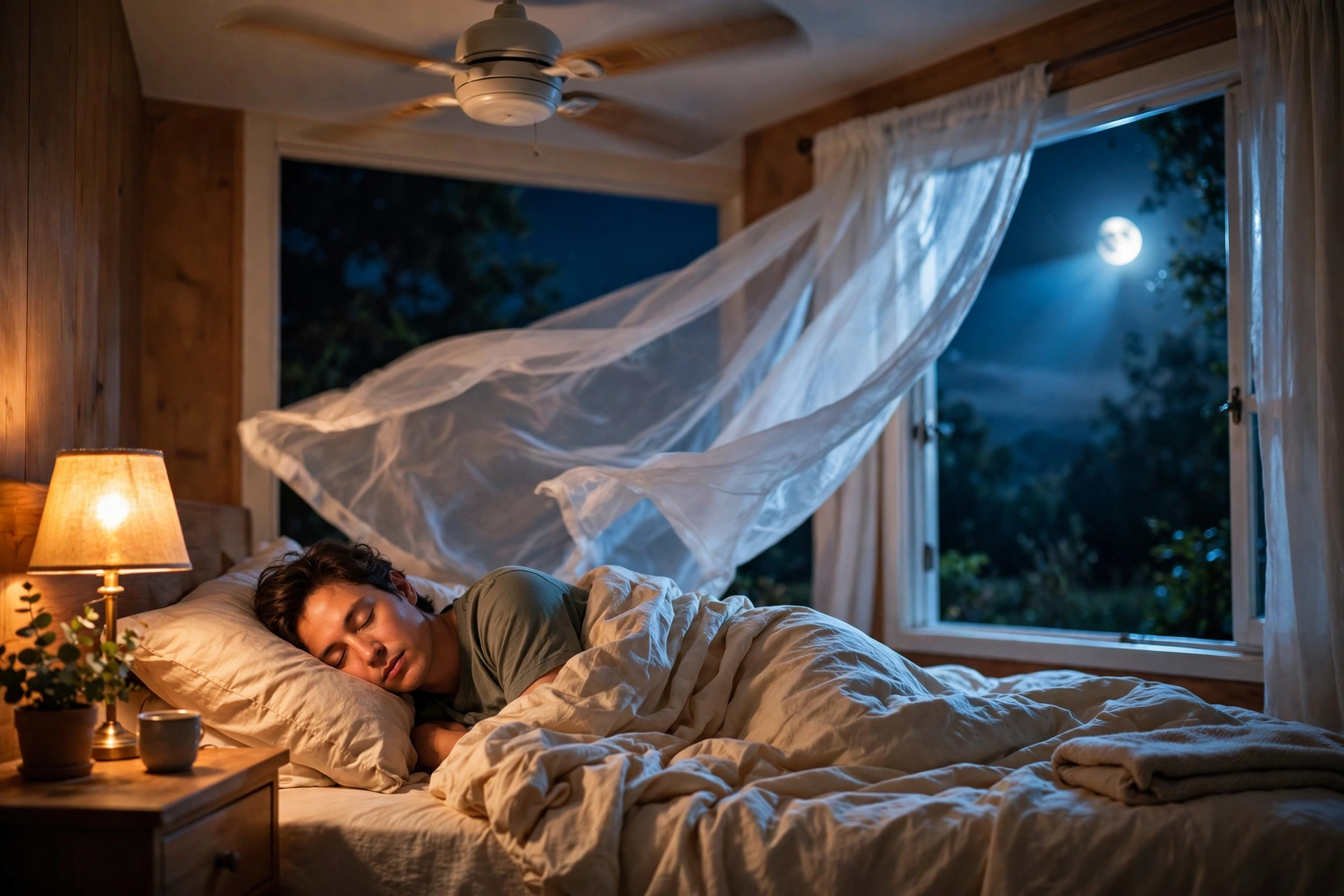
I learned how to sleep in a hot room without air conditioning the hard way — in a third-floor apartment during a heatwave that stretched on for three weeks, with a box fan wheezing in the corner and a landlord who wasn’t about to install an AC unit for me. Those first few nights were […]
I learned how to sleep in a hot room without air conditioning the hard way — in a third-floor apartment during a heatwave that stretched on for three weeks, with a box fan wheezing in the corner and a landlord who wasn’t about to install an AC unit for me. Those first few nights were brutal. I’d lie there staring at the ceiling, drenched, watching the clock crawl toward morning, and then wake up feeling like I’d run a marathon in my sleep.
But over those three weeks, I experimented. A lot. I tried everything from the obvious to the slightly ridiculous, and eventually I built a system that actually worked — I went from getting maybe four broken hours of sleep to sleeping almost normally, in a room that regularly hit 30°C (86°F) at bedtime. This guide is everything I learned, plus the science behind why heat wrecks your sleep. Every trick here costs little or nothing, and you can start using most of them tonight.
Table of Contents
Why Heat Destroys Your Sleep
Here’s the thing most people don’t understand about sleeping in heat: your body actually needs to cool down to fall asleep. It’s not a preference — it’s biology. About an hour before bedtime, your body starts lowering its core temperature by dilating blood vessels near your skin (which is why your hands and feet feel warm when you’re getting drowsy) and releasing heat. That drop in core temperature is one of the signals that tells your brain it’s time to sleep.
When the room around you is hot, your body can’t shed that heat efficiently. You stay too warm, and the entire process stalls. You toss and turn, you fall asleep but never quite sink into the deep, restorative stages of sleep, and you wake up repeatedly through the night. Researchers cite the Sleep Foundation’s ideal sleep temperature guidance — generally somewhere between 18 and 20°C (65–68°F) — as the sweet spot for most adults, and the further above that your room gets, the worse your sleep quality tends to be.
Heat also increases restlessness. You flip the pillow, kick off the sheet, pull it back on, flip the pillow again. That fragmented sleep means you wake up groggy, dehydrated, and irritable even if you technically spent eight hours in bed. So everything below is really about one goal: helping your body lose heat faster so it can do what it already knows how to do — fall asleep.
How to Sleep in a Hot Room Without Air Conditioning: The Room-Cooling Playbook
The single biggest mistake I made at first was trying to cool myself in the room while doing nothing about the room itself. Your bedroom is basically a heat battery by evening — it has been absorbing warmth all day. Cool the battery, and everything else gets easier.
Trick 1: Beat the Sun During the Day
Close your curtains or blinds during the hottest part of the day, especially on sun-facing windows. I used to keep my curtains open because I liked the light, and then I’d wonder why my bedroom felt like a greenhouse at 10 p.m. Blocking direct sunlight can keep a room several degrees cooler by evening. Blackout curtains are ideal, but even a bedsheet pinned over the window works.
Trick 2: Open Windows Strategically at Night
Once the outside air drops below the indoor temperature (usually an hour or two after sunset), open your windows — ideally on two opposite sides of your apartment to create a cross-breeze. Cross-ventilation is dramatically more effective than a single open window; air needs a path through the room, not just in. If you only have windows on one side, open your front door or a window in another room to give the air somewhere to go. Cross-breeze still helps in humid air because moving air evaporates sweat and moisture from your skin, which cools you even when the temperature itself is high.
Trick 3: Flush the Hot Air Out With a Fan in the Window
This one made a huge difference for me. Place a fan in the window blowing outward — not inward — in the hottest room of the house, ideally an hour or two before bed. This exhausts the hot indoor air and pulls cooler evening air in through your other open windows. It feels counterintuitive to point the fan away from you, but the physics is sound: you’re creating negative pressure that draws fresh air through the whole space. I did this every evening and it shaved a noticeable couple of degrees off my bedroom temperature before I ever got into bed.
Turn Your Fan Into an Air Conditioner (Almost)
A fan alone just moves warm air around. But a few clever tweaks turn it into a genuinely effective cooling device — and this is where I found the biggest wins of the whole three weeks.
Trick 4: The Frozen-Bottle Fan Trick
Fill two or three large plastic bottles with water, freeze them, and place them directly in front of your fan. As the fan blows air across the frozen bottles, the air picks up a chill — it’s a homemade version of a swamp cooler, and it’s remarkably effective for the few feet of space around your bed. The bottles need refreezing each night, so I kept a rotation: two in the freezer, two behind the fan. It’s not going to cool the whole room, but it cools your air — which is what matters.
Trick 5: Set Your Ceiling Fan Counter-Clockwise
If you have a ceiling fan, check which way it’s spinning. In summer, ceiling fans should run counter-clockwise (when you look up at them) so they push air down at high speed, creating a wind-chill effect on your skin. Most ceiling fans have a small direction switch on the motor housing — mine did, and I’d been running it on the winter setting for two years without knowing.
Trick 6: The Under-Sheet Fan
This sounds weird and it absolutely works. On the hottest nights, I aimed my box fan directly at the foot of the bed, under the top sheet or blanket. The fan inflates the sheet slightly and circulates air around your body instead of just blowing on your face. It feels like sleeping inside a gentle breeze tunnel. Loose, light cotton bedding works best for this trick.
Prepare Your Bed Like a Desert Camper
Bedding is your second environment — the microclimate between you and the mattress. Get it right and it can compensate for a warm room; get it wrong and even a cool room feels suffocating.
Trick 7: Ditch the Duvet for Breathable Layers
Heavy synthetic bedding traps body heat and turns your bed into a sauna. I switched to a single flat cotton sheet and never looked back — breathable natural fibers like cotton, linen, or bamboo wick moisture and let air move around you. If you need something on top of you to feel “covered” (I did — sleeping with nothing on top felt exposed), a thin cotton sheet is enough. Linen is even better if you can afford it; it stays cooler to the touch than cotton. Keep polyester-blend bedding far away from your summer bed.
Trick 8: Cool Your Bedding Before Bed
Fifteen minutes before sleep, put your pillowcase in the freezer — or a damp (wrung-out) towel. Slipping into bed with a cool pillowcase against your neck and cheeks is genuinely one of the most pleasant sensations when it’s hot. You can also lightly mist your sheet with a spray bottle of water; evaporation will keep it cool for a while.
Trick 9: Elevate Your Head Slightly
Heat rises — including in your body. Sleeping with your head slightly elevated (an extra pillow or a wedge) can reduce that flushed, pounding sensation in your head that makes hot nights feel so unbearable. It’s a small adjustment, but on nights when your head feels like it’s radiating heat, it takes the edge off.
Cool Your Body From the Inside Out
Sometimes the fastest answer to how to sleep in a hot room without air conditioning isn’t to change the room at all — it’s to change you. Your body is the other half of the equation, and these tricks work immediately.
Trick 10: Take a Lukewarm Shower, Not a Cold One
This is the trick people get wrong most often. A cold shower feels amazing for about ninety seconds, but then your body’s response kicks in: your blood vessels constrict to conserve heat, and you can actually end up feeling warmer afterwards. A lukewarm shower cools you without triggering that rebound. I showered lukewarm about 30 minutes before bed every night of that heatwave, and it consistently made falling asleep easier.
Trick 11: What to Wear (and What Not To)
Sleep in loose, breathable cotton or moisture-wicking fabrics — or nothing at all if you’re comfortable with that. The worst option is tight synthetic pajamas, which trap heat and sweat against your skin. I slept in a loose cotton t-shirt and shorts, and that was ideal. One nuance: sleeping completely nude isn’t always best, because without any fabric to wick sweat, moisture pools on your skin and can feel clammy.
Trick 12: Put a Cold Water Bottle at the Foot of Your Bed
Your feet are excellent radiators — they’re packed with blood vessels and sweat glands, and cooling them helps cool your whole body. A water bottle filled with cold (not freezing) water at the foot of your bed is a simple, lasting heat sink. I used a metal bottle because it conducts cold better than plastic. On brutal nights, I’d also press my feet against it for a minute before settling in — an instant whole-body cool-down.
Trick 13: Mist Yourself With a Spray Bottle
Keep a spray bottle of cool water on your nightstand and mist your face, neck, and arms when you wake up hot. The evaporating water pulls heat straight off your skin. This was my middle-of-the-night rescue move: fan, mist, roll over, back to sleep.
Remove the Hidden Heat Traps
Trick 14: Kill Your Bedroom’s Heat Sources
Your bedroom is probably generating more heat than you realize. Electronics are the big culprits: a laptop charging on the nightstand, a TV on standby, a gaming console, even phone chargers generate warmth in an enclosed room. I started unplugging or switching off everything in my bedroom an hour before sleep — chargers, the TV, the bedside lamp (switched to a cool LED). Incandescent and halogen bulbs are little heaters; if you still have them, swap them out. Even a warm reading light right next to your head adds to your discomfort.
Also worth checking: what’s below and around your bedroom. If your room sits above a kitchen or a laundry room, that heat radiates upward.
Trick 15: Sleep in the Coolest Room You Have
This is the nuclear option, and sometimes it’s the only one that works. Heat rises, so the top floor is the worst place to sleep in summer. If you have a lower floor, a basement room, or even a north-facing room that’s naturally cooler, consider moving your sleep setup there for the hottest stretch. I eventually dragged my mattress into the living room for the worst week, and my sleep improved dramatically overnight.
When the Heat Messes With Your Body, Too
One more thing I learned: heat doesn’t just keep you awake — it punishes your body in ways that make the next day worse. Tossing and turning in the heat can leave you waking up with aches you didn’t have before, including waking up with a stiff neck from sleeping awkwardly on a sweat-soaked pillow. Drink a full glass of water before bed and keep another on the nightstand — dehydration makes morning soreness and headaches much worse, and you’ll lose a lot of fluid through sweat on hot nights. And if you use an extra pillow to elevate your head, make sure it actually supports your neck rather than craning it forward.
Conclusion
Learning how to sleep in a hot room without air conditioning isn’t about finding one magic trick — it’s about stacking small advantages until your body can finally do its job. Block the sun during the day, flush the hot air out at night, weaponize your fan with frozen bottles, sleep under breathable layers, cool your body with a lukewarm shower and light clothing, and don’t be too proud to move to the coolest room in the house.
I won’t pretend these tricks turn a 30°C bedroom into a crisp autumn evening — they don’t. But they took me from four miserable hours to genuine, restful sleep, and that’s the difference between surviving a heatwave and being destroyed by it. Start with three or four of the tricks tonight (the frozen-bottle fan, the lukewarm shower, and the breathable sheet are the fastest wins), then add more as the heat stretches on. Your body already knows how to sleep. You just have to give it a fighting chance.