

How to Freeze Fresh Herbs: 7 Methods That Actually Keep the Flavor Learning how to freeze fresh herbs properly was one of those small kitchen skills that changed how I cook day to day. Every summer my little garden (and let’s be honest, the grocery store’s buy-one-get-one deals) left me with more basil, parsley, and […]
How to Freeze Fresh Herbs: 7 Methods That Actually Keep the Flavor
Learning how to freeze fresh herbs properly was one of those small kitchen skills that changed how I cook day to day. Every summer my little garden (and let’s be honest, the grocery store’s buy-one-get-one deals) left me with more basil, parsley, and cilantro than I could ever use before it wilted. I’d watch beautiful bunches turn to sad, slimy mush in the crisper drawer, and I hated wasting them. Drying worked for oregano and rosemary, but it turned my basil into something that tasted like dusty paper. So I went down the rabbit hole of freezer preservation — and honestly, it worked far better than I expected.
Here’s what I learned after several seasons of trial and error: frozen herbs won’t replace fresh ones in a garnish or a salad, but in cooked dishes — soups, stews, sauces, marinades — they’re nearly indistinguishable from fresh. The trick is knowing which method fits which herb, because a technique that gives you vibrant green basil cubes will turn your chives into a watery mess if you’re not careful. This guide walks through everything: which herbs freeze beautifully and which ones to skip, how to prep them, the ice-cube-tray and oil method I use most, flash freezing, water cubes, blanching, herb butters, and all the little mistakes I made so you don’t have to.
Table of Contents
Why I Learned How to Freeze Fresh Herbs Instead of Only Drying Them
For years, drying was my only preservation method. I’d hang bundles of herbs in the kitchen, wait two weeks, crumble them into jars, and call it done. And for woody, low-moisture herbs like thyme, oregano, rosemary, and sage, drying is genuinely great — those herbs are practically designed to be dried, and their flavor concentrates nicely.
But soft, tender herbs are a different story. Basil, cilantro, parsley, dill, chives, and mint have high water content and delicate volatile oils, and drying drives off much of what makes them taste alive. Air-dried basil goes brown and loses that sweet, peppery punch. Cilantro, dried, barely tastes like cilantro at all. Freezing, on the other hand, locks those aromatic compounds in place because the cold simply pauses everything — there’s no heat driving the flavor away. The first time I dropped an oil-frozen basil cube into a pot of tomato sauce in January, I was genuinely surprised at how much summer was still in there.
There’s a practical angle too. Freezing is faster. Drying takes days to weeks and needs the right humidity and airflow; freezing takes an afternoon. And honestly, the hardest part of learning how to freeze fresh herbs is just picking the right method for each herb — which is exactly what the rest of this guide is about.
Which Herbs Freeze Well (And Which Ones Don’t)
Not every herb handles the freezer with equal grace, and this is where most beginners go wrong — they freeze everything the same way and wonder why the results vary so much. Knowing which herbs respond well is half the battle when learning how to freeze fresh herbs; the other half is matching each herb to the right method. Here’s my honest breakdown from experience, not from a chart I read somewhere.
The all-stars of freezing are the soft, leafy herbs you use in cooking: basil, parsley (both flat-leaf and curly), cilantro, dill, mint, and chives. These are the ones that suffer most from drying and benefit most from freezing. Basil is the poster child — frozen properly in oil, it keeps its color and a remarkable amount of its flavor. Parsley is incredibly forgiving and freezes well by almost any method. Cilantro holds up surprisingly well, though it’s a touch more delicate. Dill, both the fronds and the flower heads, freezes beautifully for pickles and sauces later.
The woody herbs — rosemary, thyme, oregano, sage, marjoram, and bay — also freeze fine, especially flash-frozen as whole sprigs. Honestly, these dry so well that freezing them is optional, but if you have a bumper crop, the freezer is a perfectly good backup. Their sturdy structure means they don’t turn to mush, and they hold their essential oils well in the cold.
Then there’s the “don’t bother” list. Delicate herbs you eat raw for texture — like the tender tips you’d use as a finishing garnish — won’t survive freezing with their looks intact. Frozen herbs go limp when they thaw, full stop; that’s a texture reality, not a method failure. And tarragon is famously tricky: many gardeners find it loses flavor in the freezer, so I use mine fresh or preserve it in vinegar instead. The National Center for Home Food Preservation notes the same core reality — frozen herbs are meant for cooked dishes, not garnishes, since thawing makes them limp.
Prep Work: How to Wash and Dry Herbs Before Freezing
This step sounds boring, and I skipped it properly the first time — which is how I learned it matters. Whichever approach to how to freeze fresh herbs you choose, it starts with clean, dry herbs. Rinse them gently under cool running water to remove dust, soil, and any tiny hitchhikers. If your herbs are from your own garden and you’re sure they’re clean, a quick rinse is still worth it.
The drying part is where people get lazy, and it costs them. Excess surface water turns into ice crystals in the freezer, and ice crystals are the enemy — they rupture cell walls, which is exactly what makes thawed herbs mushy and dull. After rinsing, shake the herbs gently, then spread them on a clean kitchen towel or a few layers of paper towels. Pat them dry, then let them air-dry for 20 to 30 minutes. A salad spinner is my favorite shortcut: a few spins and the leaves come out remarkably dry without any bruising. For chives and other delicate herbs, handle them gently — bruised leaves darken faster.
Pick through and discard any yellowed, spotted, or damaged leaves now, because freezing won’t improve them. If you’re working with stemmy herbs like parsley or cilantro, decide now whether you want leaves only or tender stems included — the thin upper stems are fine to chop in, but thick woody stems should be removed. Good prep takes maybe fifteen minutes for a big batch, and it’s the foundation every freezing method builds on.
Method 1: The Ice-Cube-Tray and Oil Method (My Go-To)
If you only learn one technique for how to freeze fresh herbs, make it this one. The oil method is my default because it solves the two biggest problems of freezing herbs: air exposure (which causes freezer burn and browning) and flavor loss. The oil coats the leaves, seals out air, and carries the herb’s fat-soluble flavor compounds beautifully.
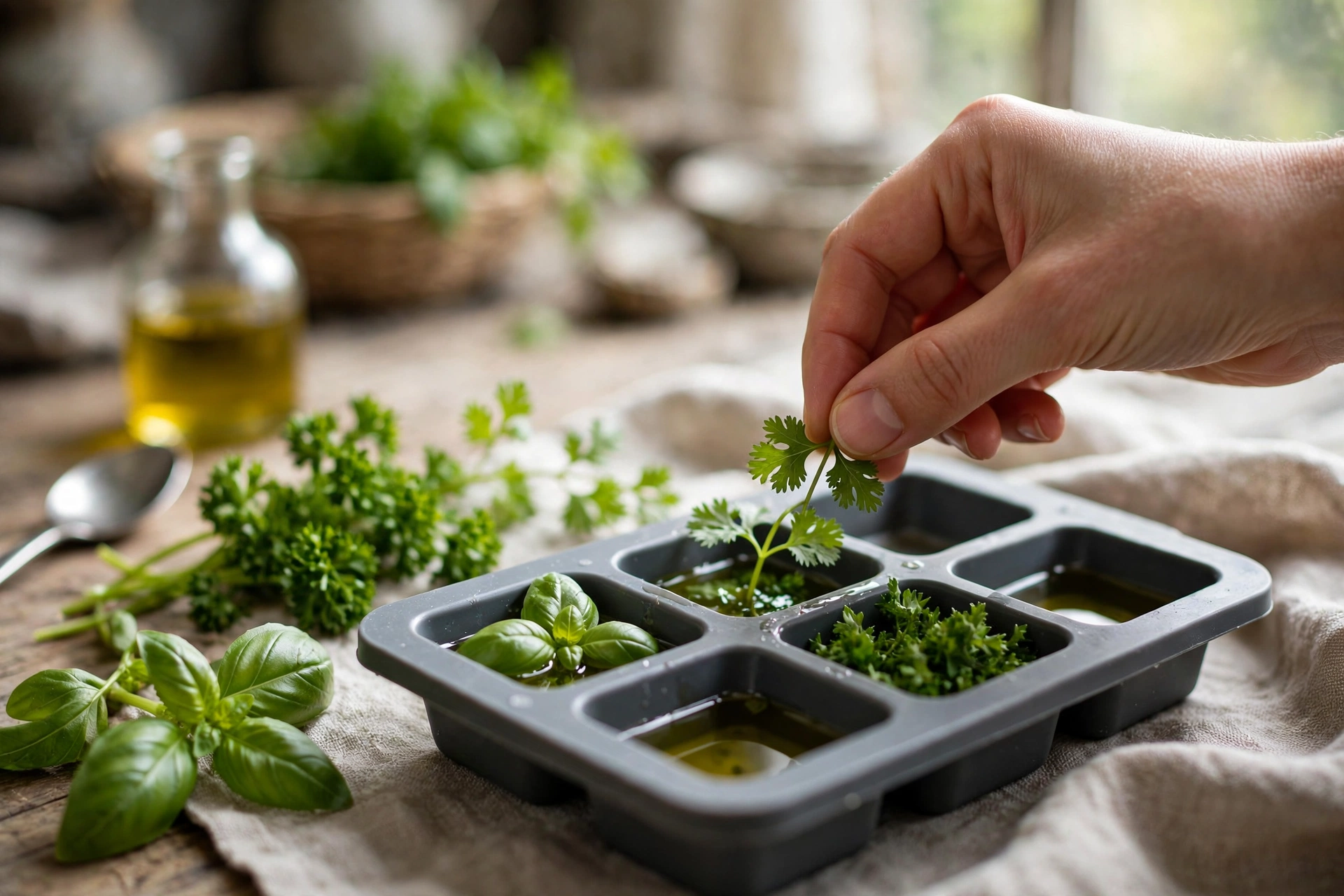
Here’s my process. Chop the herbs — roughly for sturdy ones, finely for basil and parsley — and pack them into the compartments of a standard ice cube tray, filling each about two-thirds to three-quarters full. Then pour olive oil (or a neutral oil like avocado oil if you prefer) over the herbs until they’re just covered. I use roughly a tablespoon or two of oil per cube, depending on the tray size. The herbs will want to float; that’s normal — just push them down with the back of a spoon so they’re mostly submerged.
Freeze the tray until the cubes are solid, usually 3 to 4 hours. Then pop the cubes out and transfer them to a labeled freezer bag, squeezing out as much air as possible before sealing. Of all the ways I have tested how to freeze fresh herbs, this oil method preserves basil’s color and aroma better than anything else. The cubes are portioned and ready: when a recipe calls for herbs, I drop a frozen cube straight into the hot pan or pot. The oil melts, the herbs sizzle, and it smells incredible. This method is unbeatable for basil, parsley, cilantro, and dill — the herbs I reach for most in winter cooking. One tip from experience: use a silicone tray if you have one, because herb-oil cubes can be stubborn to pop out of rigid plastic trays.
Method 2: Flash-Freezing Loose Herbs So They Don’t Clump
Sometimes you don’t want herbs locked in oil — you want loose, free-flowing herbs you can grab by the pinch, the way you’d grab them from a spice jar. That’s where flash freezing comes in, and it’s the best way to freeze fresh herbs like chives, dill fronds, thyme leaves, and rosemary needles when you want them separate rather than cubed.
The technique is simple: spread your washed, thoroughly dried herbs in a single layer on a baking sheet lined with parchment paper. Make sure the pieces aren’t touching or piled up — contact is what causes clumping. Slide the tray into the freezer and leave it for 1 to 2 hours, just until the herbs are frozen firm. Then, working quickly so nothing starts to thaw (thawing and refreezing is what fuses everything together), transfer the frozen herbs into a freezer bag, press out the air, seal, and return to the freezer immediately.
The result is a bag of individually frozen herb pieces you can shake out a tablespoon at a time. I love this for chives — snipped chives freeze into tiny green confetti that’s perfect for sprinkling over baked potatoes or eggs straight from the freezer. It also works wonderfully for whole thyme and rosemary sprigs, which you can toss into a roast or stew and fish out at the end, just like fresh. The critical detail is speed during the transfer: if the herbs start to thaw on the counter, they’ll freeze into one solid brick in the bag.
Method 3: Freezing Herbs in Water Cubes
Water cubes are the simplest method of all, and they’re perfect when you’re avoiding added oil — maybe for herbs headed into light broths, teas (mint!), or dishes where you don’t want extra fat. Chop the herbs, pack them into an ice cube tray, and fill each compartment with water instead of oil. Freeze solid, then bag and label like the oil cubes.
I’ll be honest about the trade-offs: water cubes don’t protect flavor quite as well as oil cubes, and the herbs can darken a little more. But for mint destined for iced tea or tabbouleh, or parsley going into a soup, they’re completely fine and wonderfully convenient. One practical tip — don’t fill the trays to the very top with water, since water expands as it freezes and will push herbs up and out. Leave a little headspace. And drop water cubes directly into hot liquids; don’t try to thaw them first, or you’ll end up with a sad puddle of herb water.
I keep a small bag of water-frozen mint cubes all year for drinks, and parsley water cubes for weeknight soups. They take up almost no freezer space, cost nothing, and save me from buying those sad plastic clamshells of herbs in February. If you’re wondering how to freeze fresh herbs on a budget with zero special supplies, this is your answer — just a tray and tap water.
Method 4: Blanching Herbs Before Freezing — When It Actually Helps
Blanching — dunking herbs in boiling water for a few seconds, then plunging them into ice water — is standard practice for freezing vegetables, but for herbs it’s a “sometimes” tool, not a default. Blanching deactivates the enzymes that cause flavor and color loss during frozen storage, and it sets the green color beautifully. The catch is that it also cooks the herb slightly, which can mute the fresh, bright flavor you’re trying to preserve.
So when is it worth it? I blanch sturdy herbs that I’ll store for a long time — things like parsley and dill that are going into the freezer for six months or more, where enzyme-driven flavor loss over time is the bigger risk. The process: bring a pot of water to a rolling boil, drop in the herbs for 10 to 15 seconds (no longer), then immediately transfer them to a bowl of ice water to stop the cooking. Drain thoroughly, pat very dry, and then freeze by whichever method you prefer — oil cubes or flash freezing both work after blanching.
For delicate herbs like basil and cilantro, I skip blanching entirely. The brief cooking dulls exactly the fresh top notes that make those herbs special, and the oil-cube method protects them well enough on its own. University extension guides generally agree: blanching is optional for herbs, not required. Think of it as a long-storage insurance policy for hardy herbs, not a mandatory step.
Method 5: Herb Butters and Pastes for the Flavor-Obsessed
This is the method that makes people think you’re a much fancier cook than you are. Herb butter — softened butter blended with chopped fresh herbs, a pinch of salt, maybe some lemon zest or garlic — freezes beautifully and turns an ordinary weeknight dinner into something special. A coin of basil butter melting over grilled corn or a slice of parsley-garlic butter on a steak is genuinely restaurant-level, and it takes ten minutes to make.
My basic ratio: one stick (half a cup) of softened unsalted butter to about a quarter cup of finely chopped fresh herbs. Mix thoroughly, then spoon the mixture onto a sheet of plastic wrap or parchment, roll it into a log, twist the ends, and freeze. Once firm, slice the log into coins and store them in a freezer bag — then you can grab exactly one portion at a time. Herb butter keeps well for about three months, and I label each log because frozen green blobs all look the same after a month.
Herb pastes are the butter-free cousin: blend herbs with a little olive oil (and optionally garlic, nuts, or parmesan for a pesto-style paste) into a thick paste, then freeze in ice cube trays or small jars. I make big batches of basil paste every August — no cheese, since dairy doesn’t freeze as gracefully, and I add the parmesan fresh when I use it. If you want to take how to freeze fresh herbs to the next level, pastes and butters are where the real magic happens. A cube of basil paste stirred into hot pasta with a splash of pasta water is one of my favorite winter meals, and it is proof of how well you can freeze fresh herbs when you pick the right method.
Labeling, Containers, and How Long Frozen Herbs Really Last
Let me tell you about the mystery bag. Last winter I found a freezer bag of green cubes with no label, and I spent a week sniffing thawed bits trying to figure out if it was basil, cilantro, or some unholy combination. Label everything, because it matters even more when you are learning how to freeze fresh herbs in big seasonal batches — by February every green cube looks identical. Herb name, the method (oil, water, butter), and the date — a strip of masking tape and a marker is all it takes, and future-you will be grateful.
For containers, the rule is simple: airtight and as little air as possible. Freezer-grade zip bags with the air pressed out are my workhorse; for herb butters and pastes, I double-wrap. Glass jars work too, but leave headspace since contents expand as they freeze — a cracked jar of pesto cubes is a miserable cleanup. However you pack them, squeeze or press out excess air, because air exposure is what causes freezer burn, the dry, off-flavored patches that ruin frozen food.
As for how long they last: most university extension sources, including the University of Minnesota Extension, say frozen herbs keep well for up to a year, and that’s been roughly my experience for quality. In practice, I aim to use oil and water cubes within 6 to 8 months for peak flavor, and herb butters within 3 months. They’re still safe after that — frozen food doesn’t really “expire” if it stays frozen — but the flavor gradually fades. I do a freezer audit every few months and move the oldest bags to the front, the same rotation habit I use for everything else I preserve. (Good storage habits carry over to fresh produce too — I wrote about how to keep lettuce fresh for weeks using the same first-in-first-out thinking.)
Thawing and Cooking With Frozen Herbs
Here’s the best part about frozen herbs: most of the time, you don’t thaw them at all. Oil cubes and water cubes go straight from the freezer into the hot pan, pot, or baking dish. The cube melts, the herbs release, and you’re cooking. This “cook from frozen” approach actually gives better results than thawing first, because thawing lets the herbs sit in their own meltwater and go limp before they ever hit the heat.
For flash-frozen loose herbs, sprinkle them directly into whatever you’re cooking during the last few minutes — soups, stews, sauces, scrambled eggs, grain bowls. They thaw in seconds in hot food. The one place frozen herbs don’t shine is raw applications: don’t thaw a cube of basil and expect it to work as a caprese garnish. It’ll be limp and watery. Frozen herbs are a cooked-dish ingredient, and once you accept that, you’ll stop being disappointed and start being delighted.
A useful rule of thumb for quantities: frozen herbs are a bit more concentrated than you might expect, but they’ve also lost a little brightness, so I generally substitute them one-for-one for fresh in cooked recipes and then taste and adjust. If a recipe calls for a quarter cup of fresh chopped parsley, a quarter cup of frozen (or one standard ice-cube portion) is a fine starting point. One more tip for getting how to freeze fresh herbs right: freeze in the portion sizes you actually cook with, so you never thaw more than you need. Herb butter coins are the exception — a little goes a long way, so start with one coin per serving and add more to taste.
7 Mistakes That Ruin Frozen Herbs
I’ve made every mistake on this list at least once, so consider this the condensed version of my learning curve. First: freezing wet herbs. I covered this in the prep section, but it bears repeating — surface water becomes ice crystals, ice crystals shred cell walls, and shredded cell walls mean mushy, dull herbs. Dry them properly.
Second: using the wrong container. Thin sandwich bags, uncovered trays, and containers with lots of trapped air all lead to freezer burn. Use freezer-grade bags or airtight containers and press out the air. Third: freezing herbs you should have used fresh — delicate garnish herbs with no cooking step planned. If the herb’s whole job is looking pretty on top of a dish, the freezer will betray you.
Fourth: thawing cubes on the counter before cooking. Just don’t — cook from frozen. Fifth: forgetting to label, which I already confessed to. Sixth: overfilling water-cube trays, which leads to herb icebergs erupting out of the tray as the water expands. And seventh: freezing herbs past their prime. The freezer preserves what you put in — it doesn’t improve it. Limp, yellowing basil goes in, disappointing basil comes out. Freeze your herbs at their peak, the day you buy or harvest them if you can.
Can you freeze fresh herbs without blanching them?
Yes, absolutely — blanching is optional for herbs, not required. Most home cooks freeze herbs raw using the oil-cube, water-cube, or flash-freeze methods with excellent results. Blanching mainly helps hardy herbs stored for many months by slowing enzyme activity, but for basil, cilantro, and parsley, skipping it preserves more of the fresh flavor.
How long do frozen herbs last in the freezer?
For best quality, use frozen herbs within 6 to 12 months — university extension sources generally cite up to a year. Herb butters are best within about 3 months. They remain safe to eat beyond that as long as they’ve stayed frozen solid, but the flavor gradually fades, so label everything with the date and use the oldest bags first.
Do frozen herbs taste as good as fresh?
In cooked dishes, they’re remarkably close — most people can’t tell the difference in a simmered sauce, soup, or stew. The volatile oils that give herbs their flavor are preserved well by freezing, especially in oil. Where they fall short is raw use: thawed herbs go limp, so they can’t replace fresh herbs as a garnish or in salads.
What’s the best oil to use for freezing herbs in oil?
Extra-virgin olive oil is the classic choice and adds its own pleasant flavor, making the cubes ready to drop straight into Italian-style cooking. For a neutral option that won’t steer the flavor of the dish, use avocado oil or another mild oil. Avoid strongly flavored oils unless that flavor suits the herb — and always use oil you’d be happy cooking with.
Can you freeze herbs in plastic bags without a tray?
Yes — that’s essentially the flash-freeze method without the tray step, though the tray step is what keeps pieces separate. You can also pack chopped herbs directly into a freezer bag, press it flat, and freeze; then just break off a chunk as needed. It won’t be as neatly portioned as cubes, but it works fine for parsley, dill, and other hardy chopped herbs.
Why did my frozen basil turn black?
Blackening is caused by air exposure — basil’s enzymes react with oxygen and darken the leaves, the same reason a cut apple browns. The fix is the oil-cube method: fully submerging the leaves in oil seals out air and keeps them green. Make sure leaves are pushed below the oil surface before freezing, and get the cubes into an airtight bag promptly once frozen.
The Bottom Line: How to Freeze Fresh Herbs Without Losing Flavor
If there’s one thing I want you to take away, it’s this: how to freeze fresh herbs isn’t complicated, but it is specific. Match the method to the herb and the dish. Oil cubes for basil and the soft herbs headed into cooked meals. Flash freezing for chives and sprigs you want loose and grabbable. Water cubes for mint and the budget-friendly basics. Herb butters when you want to feel like a genius on a Tuesday night. Wash and dry properly, label everything, press out the air, and cook from frozen.
I started freezing herbs to stop wasting money on wilted bunches, and it turned into one of my favorite kitchen rituals — that August afternoon of chopping and packing trays feels like putting summer in a savings account. Come January, when a cube of basil hits a pot of tomato sauce and the whole kitchen smells like the garden again, you’ll understand exactly why. For more on keeping your produce at its best, the National Center for Home Food Preservation’s guide to freezing fresh herbs is the authoritative reference I check my own methods against — and now you’ve got mine too. Happy freezing.